Research Articles
Explainers and deep dives into the geometry, spectral structure, and cross-domain investigations behind Vibrational Field Dynamics.
- Papers I–V: Spectral results on the 600-cell (computed)
- Papers VI–XI: Structural correspondences to the Standard Model
- Papers XII–XXI: Dynamical framework and quantum recovery
- Paper XXII: Programme synthesis
- Papers XXIII–XXVII (GR-I–V): Gravity from event-order geometry
- Paper XXVIII: Unification — quantum and gravity from a common geometry
- Paper XXIX: Observer as constraint — placement across regimes
- Paper XXX: Probability as constraint geometry — toward the Born rule
- Paper XXXI: Measurement as dynamical sector separation
- Charge Radii: Experimental prediction — six hadron radii from geometry
- B-Anomaly: Empirical test — one fixed geometry-derived kernel describes five flavour-physics datasets, three channels, no shape retuning
- Closure Kernel (Paper A): Operator witness — the response operator Cφ on the 600-cell, computed not fitted
- Aria-Chess (Paper B): Active-regime substrate witness — same operator beneath 18 preregistered cortical correspondences and 6 EEG signatures
- Transport Law (Selection-A): Two Schrödinger-limit theorems — explicit antisymmetric current giving exact U(1) conservation; photon-sector zero-mode spectral witness
- Adaptive Closure Transport (Selection-B): Two further theorems — explicit 2I edge-space decomposition (6 free orbits, 9 isotypic components) and a closure-derived strongly-convex Lyapunov with linear-contraction flow
- V600 Programme (Five Papers): Finite-group structure of V600 = 2I — Bekenstein 1/4 from coset incidence, monochromatic Hawking quantum on the mobile vertices, canonical τσ involution, (1 ± 1/12) trace ratios for H0 and S8 with Layer-1/2/3 discipline, and the structural-spine synthesis. Pure-Python exact-rational verification
- 24–600 Bridge Bundle (Three Papers): A foundation paper (Schläfli decomposition: V600 partitions into five disjoint 24-cells; induced action is A5, kernel is the centre), the result built on it (spectral bridge: λ=12 is the unique eigenvalue at which each local 24-cell Laplacian zero-extends into the 600-cell Laplacian; 25-dim global splits as 2·Y5 ⊕ 3·Y5 under the same A5), and a synthesis note naming the pattern (closure-projection channel: a reproducible local-to-global compatibility relation, with the λ=12 case as the first explicit instance)
- Hyperspherical Closure Cosmology: A φ-cascade derivation of the cosmological constant. Two axioms force a seven-rung descent E8 → H4 → 40 → D4 → 16 → 8 → 0 on a hyperspherical universe; all seven cosmological observables (Λ, H0, ΩΛ, H0√ΩΛ, H0·t0, w, t0) match Planck 2018 simultaneously to within 0.5%, with Λ·ℓP² matching at 0.078%. Preprint with 94 reproducible tests; four falsification windows plus one unconditional substrate-arithmetic check; not a Theory of Everything; bridge to FLRW / ΛCDM / dodecahedral topology / conformal cyclic cosmology, not replacement
- Existence / Life / Closure Programme (Three Papers + Six Notes): A self-contained programme developing closure as a structural condition for existence, living systems, and candidate point-of-view formation. Paper I (35 pp) builds the closure-operator foundation; Paper II (44 pp) extends to living-frame mechanics with 18 derived structural concepts; Paper III (19 pp) constructs a conditional bridge to phenomenal point-of-view under an explicit Access Principle conjecture. Six supporting notes (A–F) provide bioelectric, cortical, and dyadic empirical proxies. Pre-peer-review (v1.0.0-rc1); explicit Theorem / Proposition / Empirical-proxy / Pre-registered-proposal taxonomy throughout; does not claim consciousness has been proved
- The Icosian Triad (Two Papers): The mathematical core that the rest of the programme cites. Paper 1 (~30 pp) derives the triad (ℐ, G, C) — substrate, generation, closure — on V600: a 9-class Bose–Mesner scheme with ℤ[φ] eigenvalues, Cφ = L + φ−2·I, the icosian quaternion norm NH, σ-equivariance, and the exact L-function identity L(Θℐ, s) = ζK(s)·ζK(s−1) for K = ℚ(√5) (v1.1.0: C2 = 1, no local-2 correction). Paper 2 (~12 pp) catalogues five appearances of the triad across cascade, cosmology, microtubule, spectral bridge, and τ-conventions. 13 reproducible exact-arithmetic simulations; no RH claim
- The Icosian Closure Object (Four Papers): Builds on the triad's exact identity to read the object's full arithmetic shadow — ζK(s)·ζK(s−1) = ζ(s)·L(s,χ5)·ζ(s−1)·L(s−1,χ5) — and certifies mechanically that the Riemann ζ is one factor of four but is not isolated. A parameter-free prime-side Weil witness pins the one open step to a single named inequality: GRH for a cuspidal L-function, not classical RH. Read landscape → object → witness → firewall. A review draft whose centrepiece is a certified negative
- A Geometric Equivalent of the Riemann Hypothesis: The follow-on that turns the located gap into a proven theorem. Constructs the Weil quadratic form QA from the object with no free parameters and proves the equivalence QA ≥ 0 ⇔ RH(L) — a concrete new member of the RH-equivalent families. The equivalence is proved; the positivity is the open frontier. A proven equivalence, not a proof of RH
- The Closure Picture (Programme Manifesto): An ~80-page compendium integrating the wider VFD programme — "a structure exists insofar as it is fixed by its own coherence operator", one substrate across four domains (universe, life, number, mind), four-tier scope framework with falsifiers per claim, bridge-status registry, six domain-specific reader sequences. No new mathematics; no new empirical claims; the spine of the programme written down once. The canonical entry point
The strongest results are spectral and algebraic; the physical identifications are structural correspondences and remain to be tested.
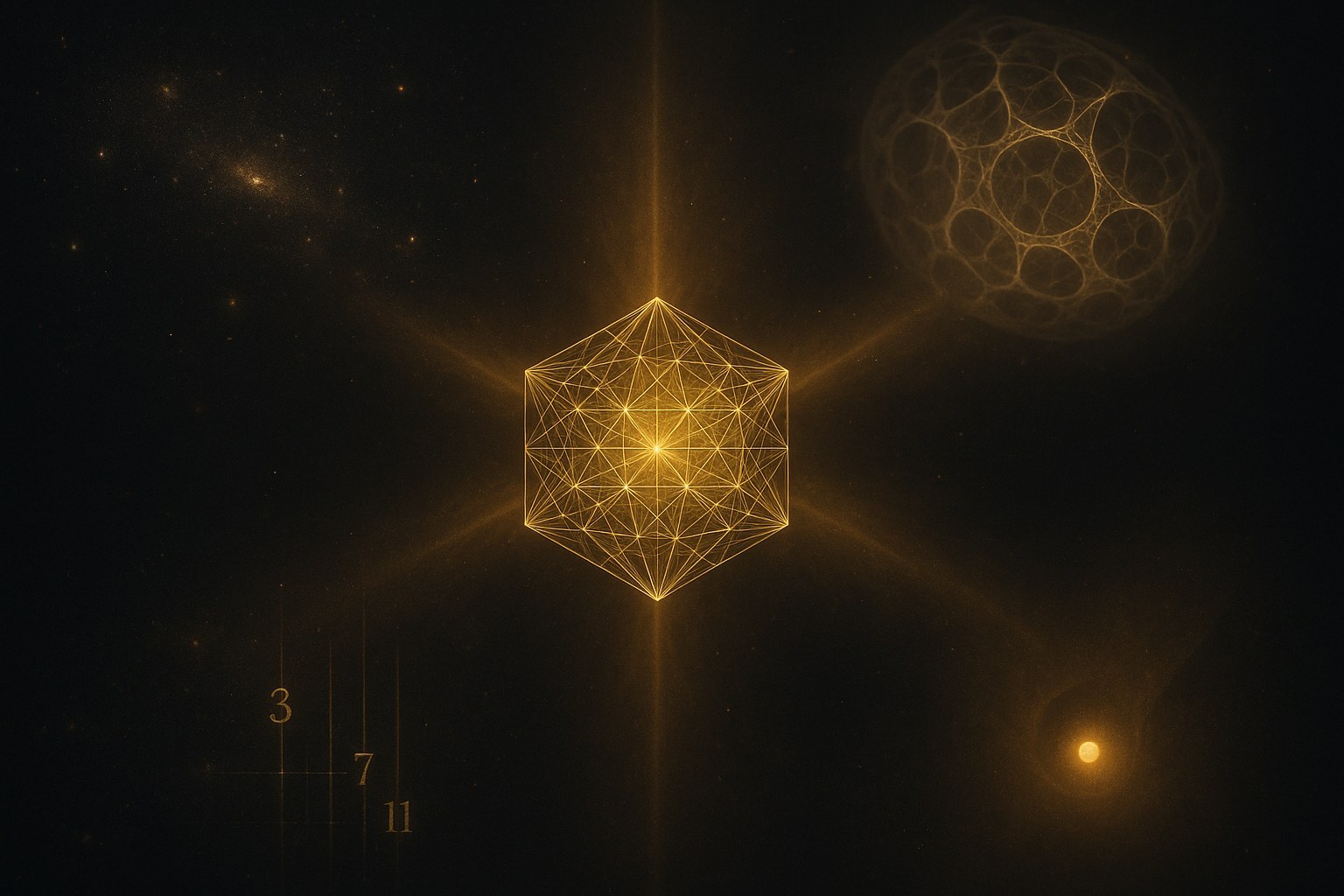
A two-paper bundle providing the core algebra that the closure-picture compendium cites for its proofs. Paper 1 derives the icosian triad (ℐ, G, C) — substrate, generation, closure — on V600, the unit group of the maximal icosian order over ℚ(√5), with a 9-class Bose–Mesner association scheme, σ-equivariance, and an icosian L-function identity. Paper 2 catalogues where the triad appears across the wider VFD programme (cascade, cosmology, microtubule, spectral bridge, τ-conventions) with marked conditionality per row.

A paired-preprint bundle. The same geometry-fixed operator Cφ on the 600-cell graph — with no shape parameters tuned to any dataset — threads two domain-disjoint empirical witnesses: passive-regime flavour physics (b-anomaly, see card below) and active-regime cortical dynamics (aria-chess). Paper A defines and proves the operator. Paper B is the active-regime substrate witness.
A second paired-preprint bundle. The closure-kernel papers asked what the operator is; this bundle asks what dynamics it carries. Paper A delivers two unconditional Schrödinger-limit theorems on the fixed substrate; Paper B extends to the adaptive regime where the substrate co-evolves with the field, with two further theorems and a conditional selection hypothesis whose six analytic conditions are all discharged on the worked example.
Five papers on the finite-group structure of the binary icosahedral group V600 = 2I, landed together as one mathematical bundle. Pure-Python exact-rational verification, no NumPy/SymPy/floats. Coset incidence (Bekenstein 1/4), vertex spectrum (monochromatic Hawking quantum), canonical τσ involution, two cosmological trace ratios (H0/S8 with Layer-1/2/3 discipline), and a structural-spine synthesis. The arithmetic foundation that downstream programmes (closure-kernel, gravity, selection-layer) cite without re-deriving.
vfd_v600), 39 pytest cases, five exact-rational certificates totalling ~700 lines. Deliberately does not claim a unified physical theory.
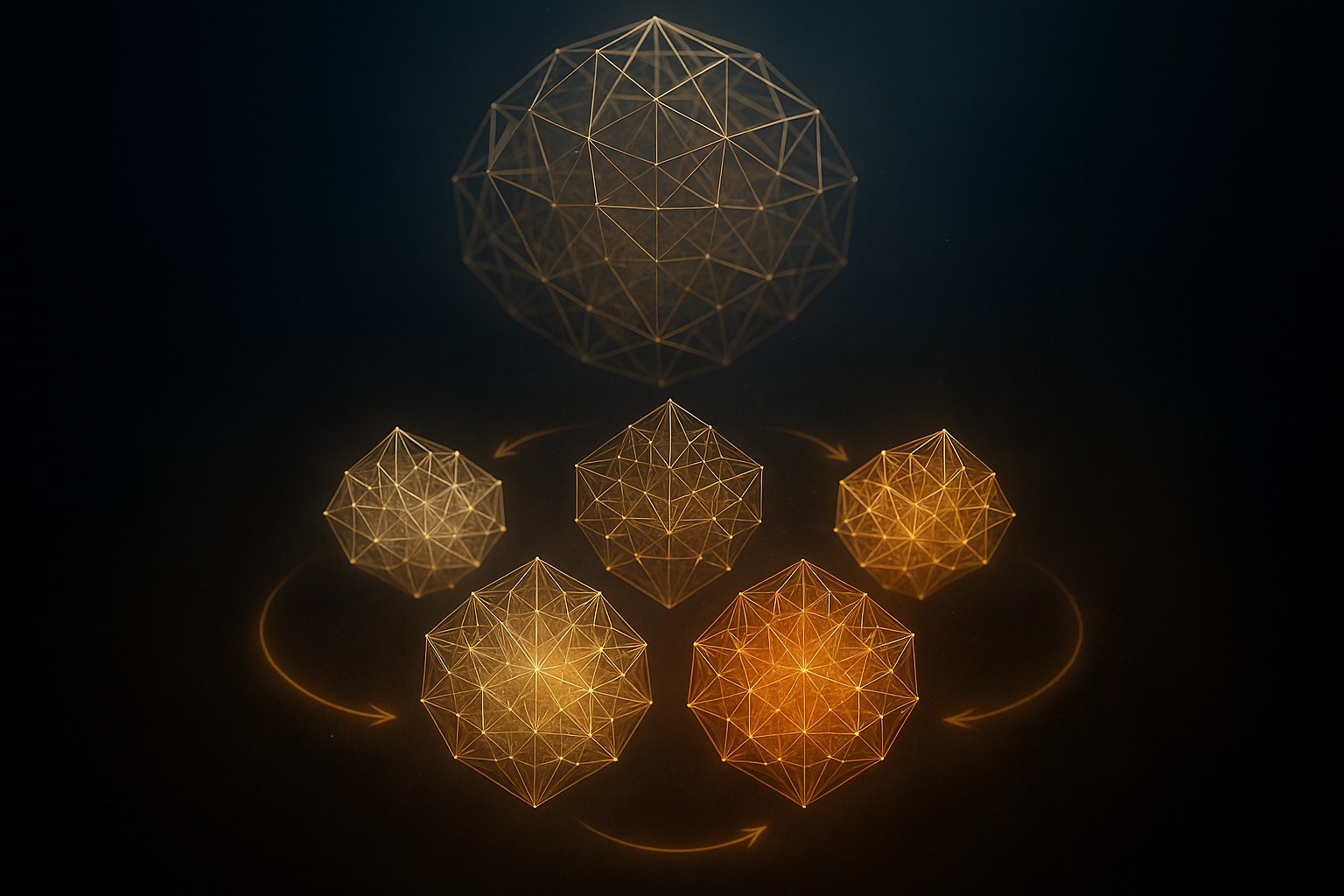
A three-paper bundle in the same repository. Paper 01 (Schläfli decomposition) establishes the foundation: V600 = 2I partitions into five disjoint 24-cells (right cosets of 2T < 2I) with induced action equal to A5 ⊂ S5 and kernel the centre {+1, −1}. Paper 02 (spectral bridge) is the result built on top: only λ=12 lifts from local 24-cell Laplacians into the global 600-cell Laplacian, and the 25-dim global eigenspace splits as 2·Y5 ⊕ 3·Y5 under the same A5. Paper 03 (the synthesis) is a five-page reader's map: it names the pattern those two exact results together exhibit — a closure-projection channel, a reproducible local-to-global compatibility relation — and identifies the λ=12 case as one positive instance and a negative-control template for the general selection question that the next paper in the programme will attempt to formalise.



Seven papers constructing a structural route from dissipative dynamics to the Schrödinger equation. Read the overview →
Recommended order: XXI (synthesis) → XVII (obstruction) → XVIII (breakthrough) → XIX–XX (residual) → XV–XVI (how we got here)

Five papers reconstructing gravitational structure from discrete geometry. No spacetime assumed. Read the overview →
Sequence: GR-I (events) → GR-II (observers) → GR-III (metric) → GR-IV (curvature) → GR-V (dynamics)