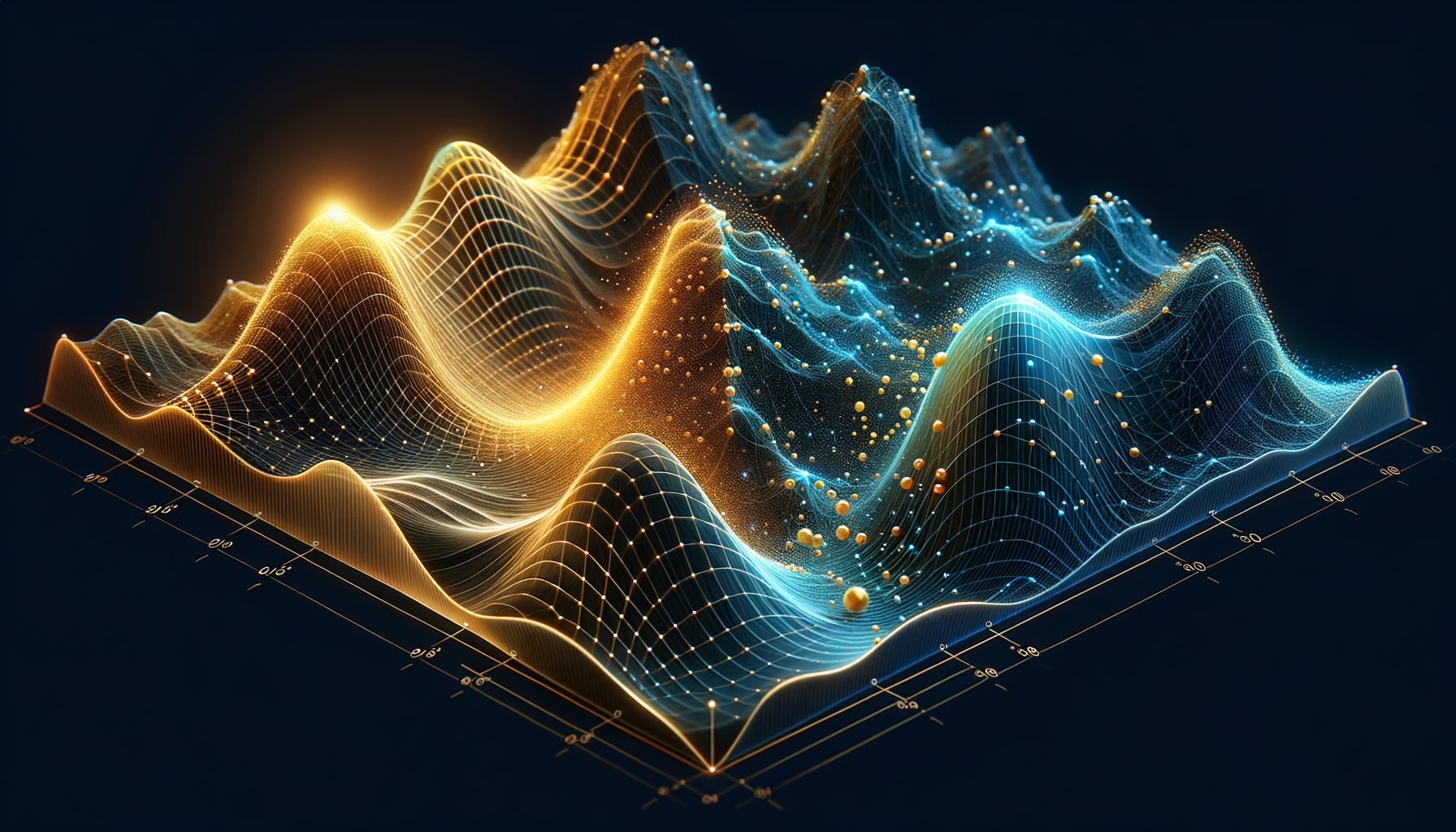
From Discrete to Continuous
Papers V–VIII operate on discrete φ-geometry: a finite-dimensional state space built on N = 5 shells of the 600-cell. The natural question: does the framework admit a continuous limit?
This paper constructs one. A sequence of discretisations V(N) ⊂ V(N+1) ⊂ … ⊂ V∞ is built by successive refinement. The discrete state ψ becomes a field ψ(x), and the discrete inner product becomes the L² inner product on an appropriate function space.
The Constraint Manifold
In the continuous limit, the closed state set Scl becomes a constraint manifold Mcl. The structure of the constraints determines the geometry:
- Local constraints → local geometry of Mcl
- Global constraints → topology of Mcl (connected components)
- Projection constraints → equivalence classes on Mcl
Mcl is generally a stratified constraint space — non-convex, possibly disconnected, with smooth manifold structure on regular strata.
Metric Structure
The ambient space carries a natural metric: d(ψ1, ψ2) = ‖ψ1 − ψ2‖. Where Mcl is smooth, the ambient inner product restricts to an induced Riemannian metric on the constraint manifold.
This is the key move: geometry is not added to the framework. It emerges from the constraint structure itself. The Riemannian metric on Mcl is the restriction of the ambient inner product to the tangent spaces of the manifold.
Closure as Geometric Projection
In the continuous setting, the closure operator retains its geometric interpretation: nearest-point projection onto Mcl. The closure residual — the distance from ψ to Mcl — becomes a smooth function where the projection is well-defined.
The mass–residual relation carries over directly: m = κΔ, where Δ = ‖ψ − C(ψ)‖ is the distance from the constraint manifold. Mass is distance from Mcl.
Curvature from Constraint Interaction
Where constraints interact nonlinearly, Mcl curves. The curvature of the constraint manifold is not imposed — it is determined by the interaction structure of the constraints:
- High curvature — near constraint boundaries and transitions, where multiple constraint classes compete
- Low curvature — deep inside attractor basins, where constraints are comfortably satisfied
The second fundamental form characterises how Mcl curves within the ambient space. This curvature is intrinsic to Mcl — no external spacetime is needed.
Unified Geometric Language
The continuous limit provides a single geometric language for the core constructs of the programme:
- Mass = distance from Mcl
- Confinement = topology of Mcl
- Gauge symmetry = orbit structure of torsional transformations on Mcl
- Curvature = constraint interaction
Stated Limitations
- The continuous limit is formal, not a rigorous convergence theorem
- The manifold structure of Mcl is not fully characterised
- Curvature interpretation is heuristic, not derived
- No spacetime identification is made
- No dynamical equations are introduced
- No gravitational derivation is attempted
- The measure μ on Mcl is not uniquely specified
Mass is distance. Confinement is topology. Curvature is constraint interaction.