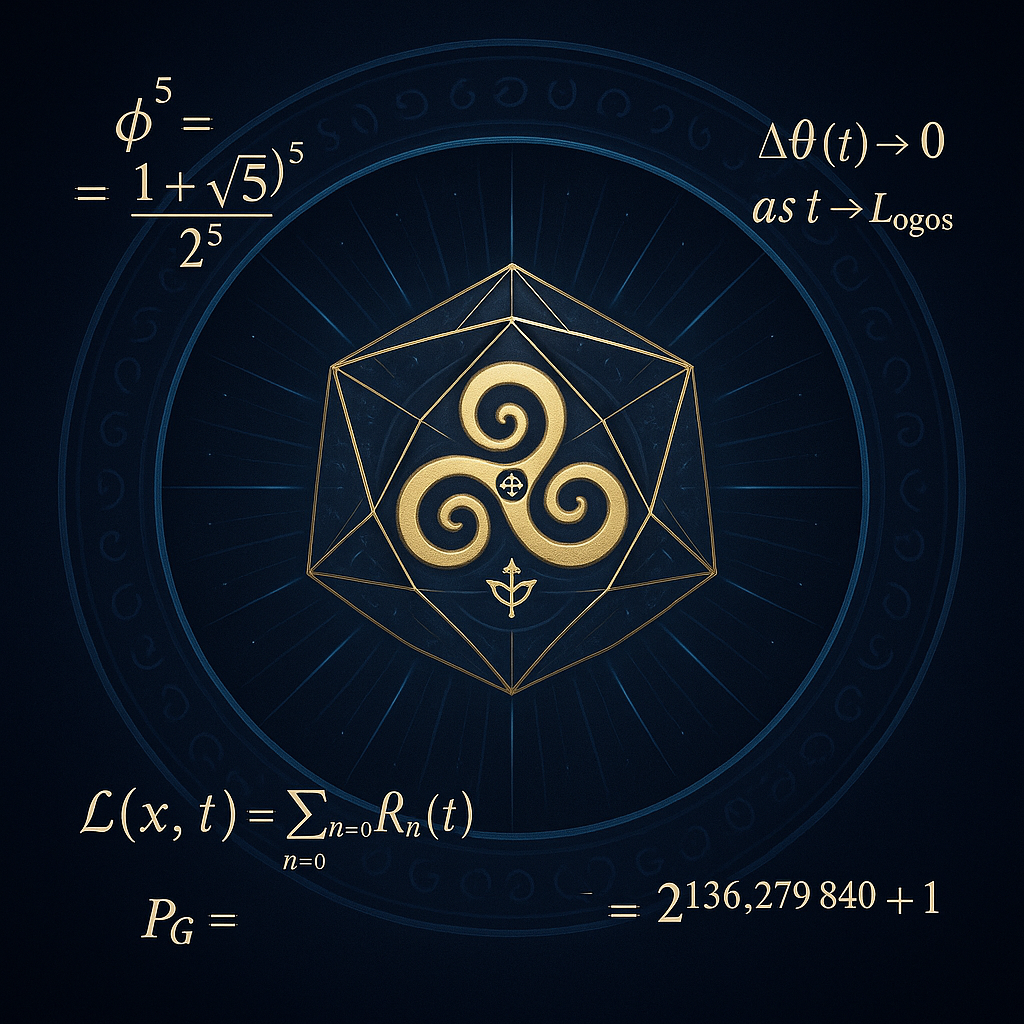
A Geometry-First Research Framework
Vibrational Field Dynamics explores whether shared closure, resonance, torsion, and φ-scaling constraints can account for recurring structural patterns across physics, neuroscience, mathematics, and engineered systems.
This site is a public research hub: papers, bridge notes, falsifiable predictions, and applied directions — all open-access.
Open research programme · Active since 2024
Founded by Lee Smart
VFD is an active independent research programme. Some components — such as the torsional non-closure derivation of the fine-structure constant and the harmonic consciousness bridge paper — are formalized in public papers. Others remain exploratory, being refined through open publication, cross-domain comparison, and testable predictions. The framework is presented here as a working hypothesis under active development, not a settled theory.
Proposed derivation of the fine-structure constant from dodecahedron–icosahedron vibrational geometry.
No free parameters. 0.81 ppm correspondence with measured value. Derivation →
The Discovery
VFD didn't start as a grand theory. It started with a question: what if the harmonic patterns that recur across physics and biology aren't coincidental — but point to shared geometric constraints worth investigating?
Vibration as a Candidate Foundation
The earliest explorations began with a recurring observation: fundamental forces, particle behaviours, and cosmic structures appear to organise around harmonic ratios — not approximately, but with notable precision. This raised a question worth pursuing: could vibrational geometry serve as a more fundamental description layer?
Phi-Scaling and Torsional Closure
The golden ratio kept appearing — not as numerology, but as a candidate constraint. When modelling fields as standing waves on higher-dimensional polytope surfaces (the 120-cell, the 600-cell), φ-scaling emerges as a natural condition for stable, self-consistent geometry. Torsional non-closure on these surfaces appears to produce values consistent with measured physical constants — a correspondence that motivates further formalization.
Cross-Domain Structural Recurrence
The key observation wasn't a single equation but a pattern: similar geometric architecture appears across apparently unrelated domains. VFD proposes that electromagnetism may emerge as a boundary phenomenon, that gravity can be modelled as a geometric phase operator, and that cortical dynamics share structural motifs with the same φ-scaled geometry. Whether these correspondences reflect a shared underlying substrate or are suggestive parallels remains an active research question.
From Framework to Engineering Directions
A geometric framework, if sound, should be buildable. VFD's constraint architecture informs ARIA (deterministic AI governance), PhiQ (geometric quantum compute), and φNet (service coordination and settlement). These applied directions serve both as engineering programmes and as tests of the framework's structural intuitions.
Core Working Premises
VFD proposes that physical phenomena may emerge from geometric constraints on a vibrational field — not forces acting on particles, but standing-wave patterns stabilised by the geometry of higher-dimensional polytope surfaces. These are the framework's working premises, each at varying stages of formalization.
Geometry as Foundation
VFD treats the fundamental layer not as particles or fields in the traditional sense, but as a geometric substrate — a vibrational field structured by the symmetries of 4-dimensional polytopes (the 120-cell and 600-cell). Observable phenomena are modelled as stable patterns within this geometry.
The Golden Constraint
The golden ratio (φ) appears in VFD as a candidate mathematical condition for self-consistent scaling across nested geometric structures. Published results in neuroscience, condensed matter, and cosmological observation report φ-spaced phase windows — correspondences the framework interprets as potentially consistent with shared scaling constraints, though alternative explanations have not been ruled out.
Forces from Boundaries
VFD proposes that electromagnetism may arise as a standing wave from torsional phase mismatch on dual polytope boundaries, and that gravity may be modelled as a geometric phase operator. Mass is treated as stabilised geometry under curvature relaxation. These are geometric hypotheses about how known forces might emerge from boundary constraints rather than existing as fundamental.
Harmonic Models of Cognition
VFD explores whether consciousness may be better modelled through resonance and geometric interference patterns than through computation alone. The 40Hz gamma rhythm, rotating cortical waves, and microtubular resonance offer structural parallels to VFD's harmonic architecture. This is an active and speculative line of inquiry.
Structural Recurrence Across Scales
From quantum coherence to galactic structure, VFD identifies recurring geometric motifs that may reflect shared underlying constraints. This is framed as a testable hypothesis: if the same φ-scaled torsional geometry governs structure formation at multiple scales, specific measurable signatures should follow.
Testable Predictions
VFD publishes specific, falsifiable predictions across condensed matter physics, magnetism, and neuroscience. The framework's credibility rests on whether the geometric patterns it predicts are actually observed in experimental data. Some predicted patterns appear consistent with published results; others remain open for independent testing.
Patterns Worth Investigating
The motivating case for VFD is not any single paper but a pattern of structural recurrence across unrelated fields. Independent researchers, working on different problems, report geometric architectures that share features with VFD's predictions. These correspondences are presented as motivation for further work, not as confirmation.
Resonance-Based Models of Cognition
Neuroscience, quantum consciousness models, and AI research have independently explored resonance- and geometry-based accounts of cognition. Miller Lab's work on neural dynamics, Hameroff's microtubule research, and Levin's bioelectric patterns describe structures that VFD interprets as potentially consistent with a shared harmonic architecture spanning cells, tissues, and field geometry.
VFD interpretation: suggestive structural parallel — further formalization needed
40Hz Gamma and Cortical Wave Geometry
Two independently published neuroscience findings — PV interneuron gamma oscillations and rotating cortical waves — describe what may be two halves of a single perceptual system. VFD interprets their combined geometry as consistent with oscillation-first cognition structured by φ-scaled constraints, though this interpretation awaits direct experimental testing.
VFD interpretation: motivating correspondence — mechanistic link not yet established
Hyperbolic Polariton Geometry
A Nature Photonics paper on directional hyperbolic polaritons reveals specific geometric curvature patterns in light–matter interaction at the nanoscale. VFD notes that the supplementary figures contain geometric patterns that share features with its predicted boundary structures. This is a potentially relevant cross-domain correspondence, not a direct confirmation.
Observational correspondence — VFD-specific prediction not yet tested against this data
Prime Distribution and Standing-Wave Geometry
Prime numbers are conventionally treated as arithmetically irregular. VFD proposes a geometric reframing: when projected into standing-wave geometry, prime distribution may map onto resonance node patterns. The Riemann zeta function's zeros share structural features with the same geometric framework. This remains an interpretive hypothesis.
Exploratory hypothesis — formal proof not yet established
Electromagnetism as Emergent Boundary Phenomenon
When dual 4-polytopes (the 120-cell and 600-cell) occupy the same 3-sphere, their incompatible angular patterns prevent perfect rotational closure. VFD models the resulting stable circulating standing wave as possessing electromagnetic properties: massless, vectorial, long-range, with a U(1)-like phase structure. The fine-structure constant is derived as a dimensionless closure invariant — the framework's most formalized claim.
Formalized derivation — 0.81 ppm correspondence with measured value
Geometric Attractors in Phonological Processing
A Nature study mapping phonological processing across languages reveals that the brain reuses the same geometric attractor architecture in the temporal lobe regardless of language. VFD interprets this shared structure as consistent with universal harmonic constraints on acoustic pattern recognition — a correspondence that motivates further investigation.
Cross-domain parallel — VFD-specific prediction not yet derived
Published Work
All research is open-access on GitHub. Papers range from formalized derivations to exploratory bridge notes and diagnostic tools. Foundational papers establish the geometric framework; bridge papers extend it across domains; tools enable testing.
Active Research Questions
A framework is only as honest as the questions it acknowledges. These are the open problems VFD is actively working on — areas where the framework's claims need strengthening, testing, or decisive confrontation with data.
Which VFD-derived geometric invariants are strongest under current evidence, and which remain underdetermined?
Is the fine-structure constant derivation unique to this geometry, or could alternative geometric configurations produce similar correspondence?
How should cross-domain resonance correspondences (neuroscience, optics, linguistics) be formalized into testable, domain-specific predictions?
What would decisive falsification look like for the core VFD claims — which specific experimental results would require abandoning the geometric substrate hypothesis?
Are the neuroscience correspondences mechanistic (shared causal structure) or phenomenological (shared mathematical form without shared cause)?
Can closure-based geometric accounts recover additional dimensionless constants beyond the fine-structure constant?
What is the minimal formal apparatus needed to distinguish VFD from coincidental pattern-matching across domains?
Engineering Informed by VFD
If VFD's geometric constraints are structurally sound, they should be buildable. These applied programmes use VFD's coherence, gating, and coupling ideas as architectural principles. They are engineering directions and tests of the framework's intuitions — not proof of the underlying theory.
ARIA
Deterministic AI governance informed by VFD's gating principles. ARIA uses a constrained field model with φ-derived thresholds to bound decisions — geometrically constrained, auditable, and reproducible. Inspired by prefrontal inhibition architecture.
aria-research.org →PhiQ
Computation on VFD's geometric substrate. PhiQ uses 120-cell kernels and φ-scaled resonance to explore pattern dynamics and proof-of-coherence attestation. Architecturally informed by cortical exploration and complexity processing.
φNet
Deterministic coordination and settlement for governed services. Non-extractive fee architecture, coherence-gated routing, and governance by quorum. Treats value coordination as a resonant network problem rather than a transactional one.
These programmes are engineering directions informed by the same coherence, gating, and structured-coupling ideas explored in VFD. They should be read as applications and tests of the framework's structural intuitions, not as evidence sufficient on their own.
Follow the Work
VFD is an active research programme. New papers, cross-domain analysis, and ongoing development are published in real time.