
The Core Idea
This work investigates a simple question: what happens when a field evolves on a highly symmetric, finite geometric structure?
Using the 600-cell — a four-dimensional regular polytope with H₄ symmetry, 120 vertices, and 720 edges — we find that the resulting system is not generic. Instead, it exhibits:
- A highly compressed spectrum (9 eigenvalues across 120 degrees of freedom)
- Persistent localisation of energy
- Coherent recurrence across geometric shells
Paper I — Coherent Dynamics on H₄
The first paper defines a real scalar field on the vertex graph of the 600-cell and introduces a prototype dynamical equation incorporating the H₄ graph Laplacian. The linear eigenmode spectrum is computed explicitly.
The system is then extended to include nonlinear self-interaction, creating a lattice of 120 coupled nonlinear oscillators constrained by the symmetry geometry of the polytope.
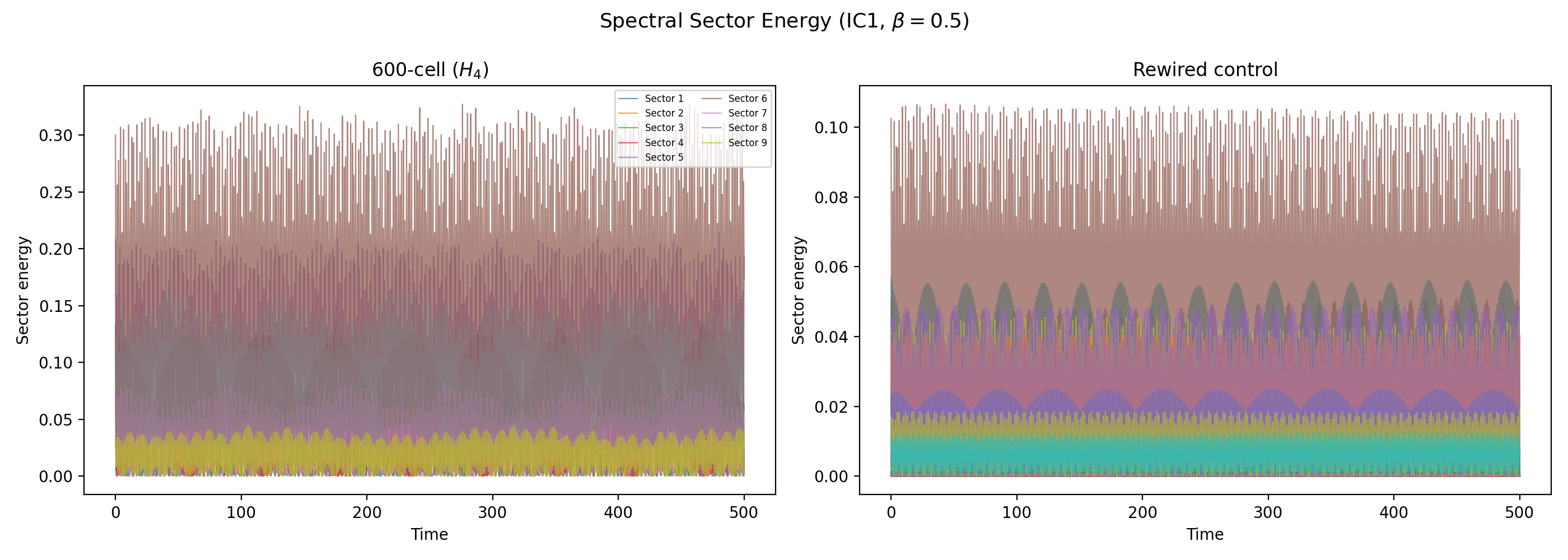
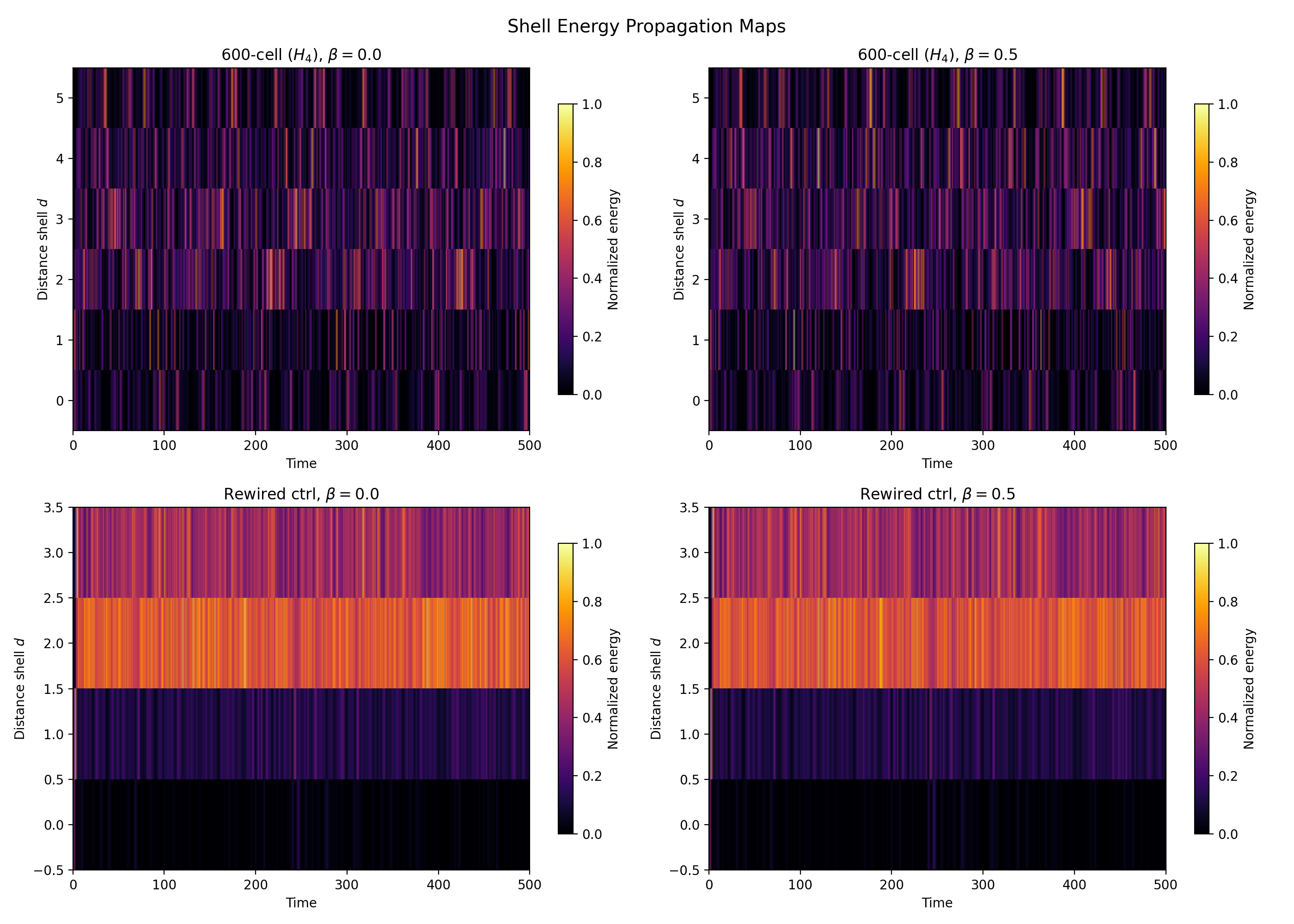
The system does not behave like a typical network. Energy does not spread uniformly. Instead, it repeatedly localises and re-forms in a structured, oscillating pattern — a breathing dynamic driven by the compressed spectral structure.
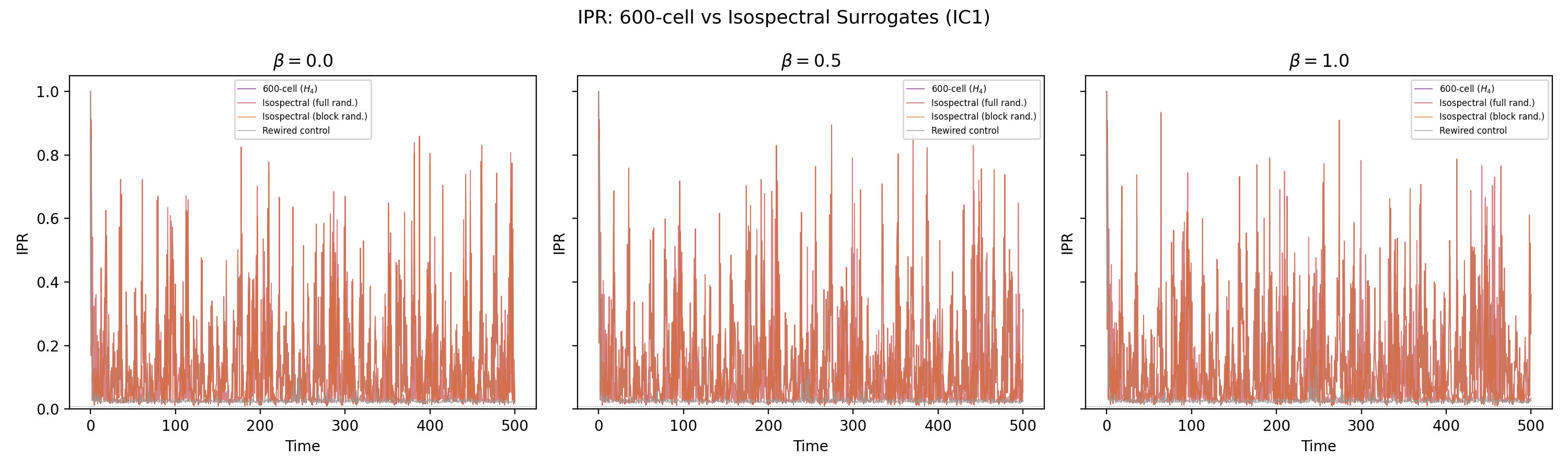
The 600-cell exhibits 5× greater localisation enhancement than degree-matched control graphs, and generates only 36 beat frequencies compared to 7,000+ in alternative structures of similar size.
Paper II — Algebraic Invariants of the Spectrum
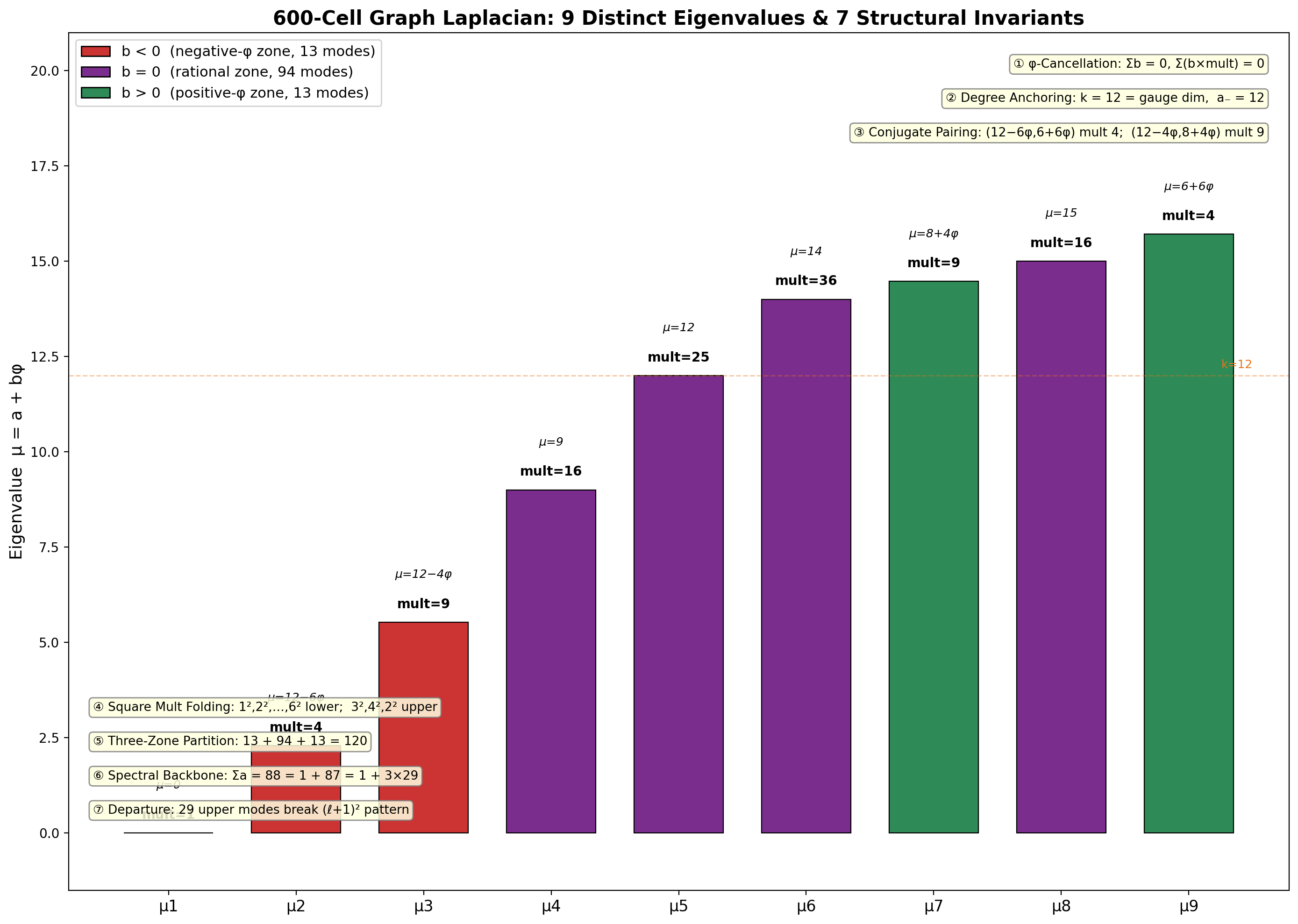
The spectrum underlying this behaviour is not arbitrary. The second paper analyses its internal algebraic structure and identifies seven structural invariants that govern the eigenvalue distribution.
φ-Cancellation. The irrational (√5) components of the spectrum cancel exactly when summed, both raw and multiplicity-weighted.
Degree Anchoring. The graph degree k = 12 serves as a spectral anchor — all irrational eigenvalues with negative φ-coefficient have rational part equal to 12.
Conjugate Pairing. All irrational eigenvalues appear in Galois conjugate pairs under √5 → −√5, with equal multiplicities.
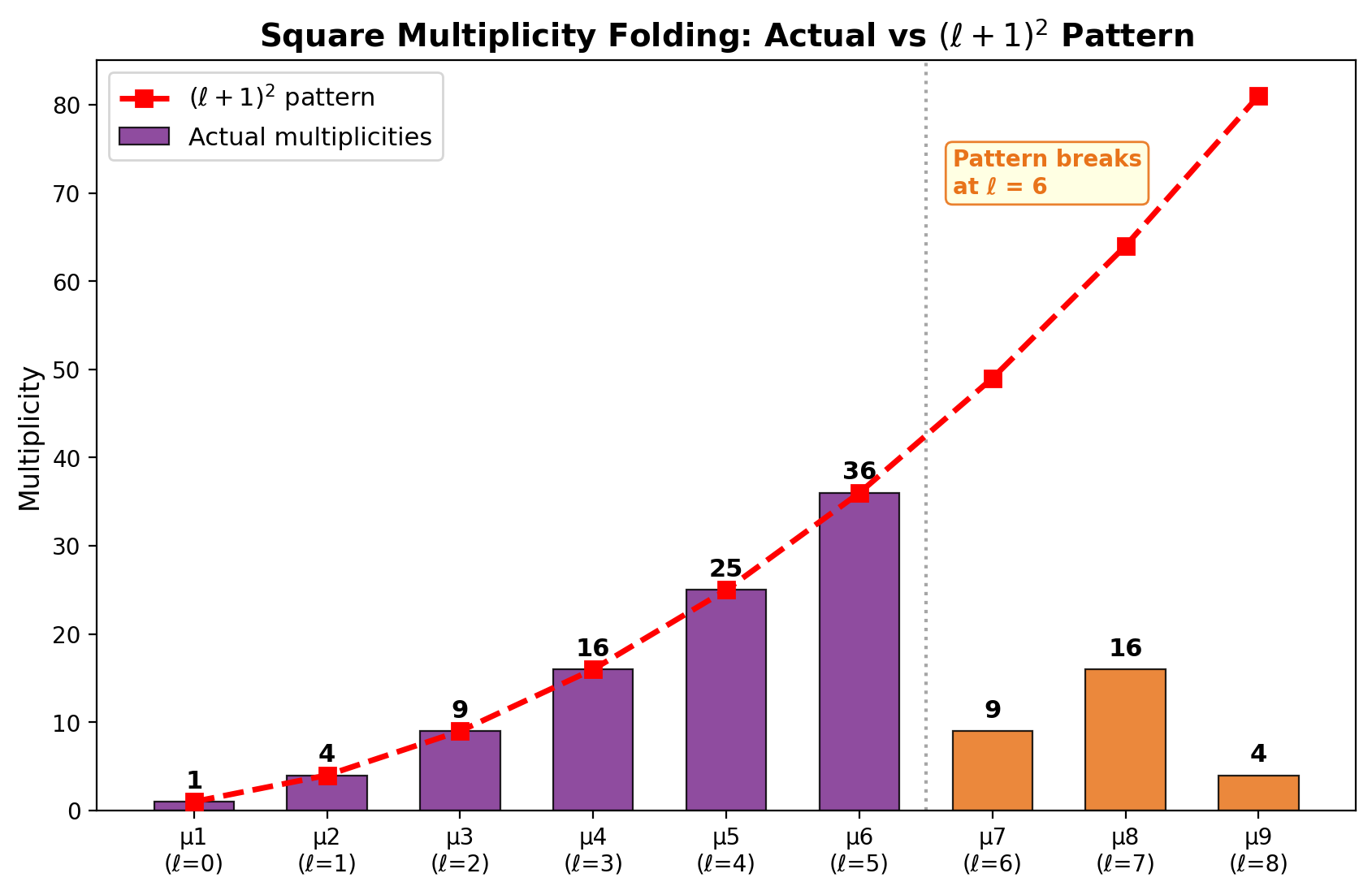
Square Multiplicity Sequence. The first six multiplicities follow the perfect-square sequence 1², 2², 3², 4², 5², 6² = (1, 4, 9, 16, 25, 36).
Three-Zone Partition. The spectrum splits into three zones by φ-content: S− (negative), S₀ (rational), and S+ (positive), with symmetric outer zones.
Spectral Backbone. The five rational eigenvalues decompose into a linear and quadratic component: {0, 9, 12, 14, 15}.
Discrete Departure. The multiplicity sequence departs from the spherical harmonic pattern (2ℓ+1)² at sector 7, quantifying the finite-size correction from S³ to the 600-cell.
Why This Is Interesting
Most graphs of this size and degree exhibit many distinct eigenvalues, uniform energy spreading, and no coherent recurrence. A typical 120-vertex, 12-regular graph would have approximately 120 distinct eigenvalues.
The 600-cell is different. It combines:
- Strong symmetry (the H₄ Coxeter group, order 14,400)
- Finite size (120 vertices)
- Non-generic spectral structure (9 eigenvalues with algebraic constraints)
This combination produces coherent dynamical behaviour — persistent localisation, structured recurrence, spectral banding — that is absent in degree-matched control graphs. The spectral compression is not generic; it is a consequence of the exceptional geometry.
What This Does Not Claim
- A complete physical theory
- A direct mapping to known particles or forces
- A replacement for existing physics
- That the dynamical behaviour requires a specific physical interpretation
This work establishes a mathematical structure and demonstrates its dynamical consequences. The results are presented as properties of a well-defined geometric and algebraic system.
Outlook
The results suggest that certain finite geometries may encode structured dynamical behaviour through their spectra. The 600-cell appears to be one such geometry — perhaps the most extreme example within the family of regular polytopes.
Further work will focus on:
- Exact representation-theoretic derivation of the eigenmode structure
- Classification of other geometries exhibiting similar spectral compression
- Deeper connections to known mathematical systems (E₈ lattice, Coxeter groups)