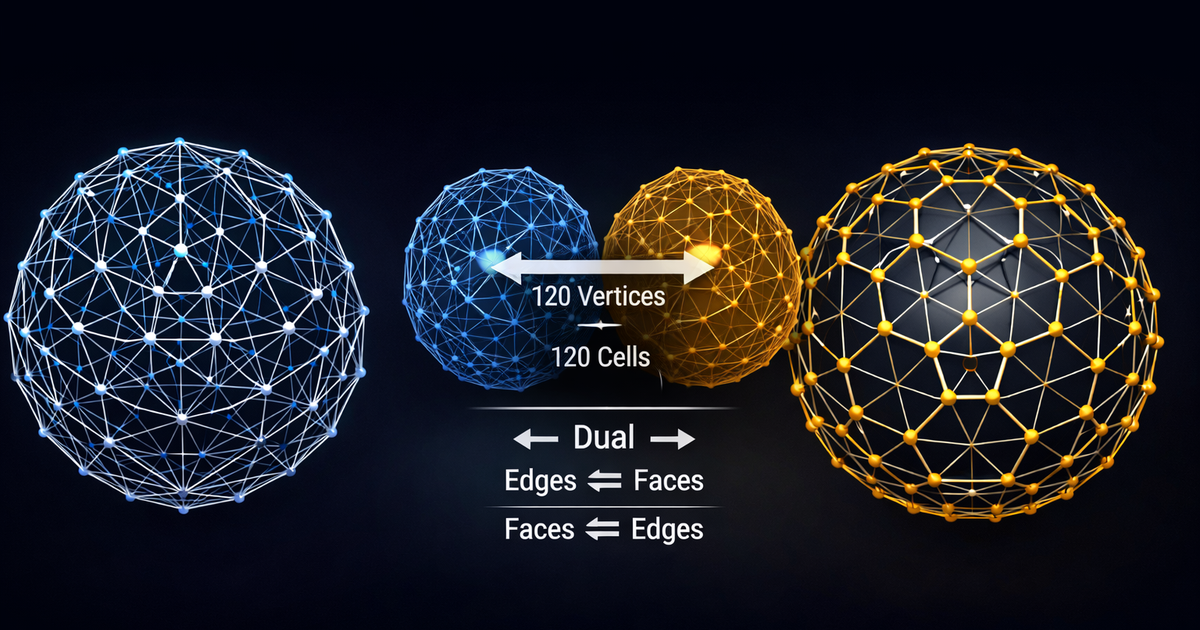
Four dimensions contain six regular polytopes — the higher-dimensional analogues of the Platonic solids.
Among these, the 600-cell and the 120-cell form the most intricate dual pair ever discovered. Their relationship reveals a remarkable example of symmetry and structure in higher-dimensional geometry.
Understanding this pair offers insight into the structure of four-dimensional space and provides a useful conceptual model for thinking about how local structure and global closure can coexist in a unified geometric framework.
The Regular Polytopes of Four Dimensions
In three dimensions there are five regular solids, known as the Platonic solids: the tetrahedron, cube, octahedron, dodecahedron, and icosahedron.
When geometry extends into four dimensions, six regular polytopes exist. Among these, two stand out for their extraordinary symmetry:
- The 600-cell
- The 120-cell
These two form a perfect dual pair.
The 600-Cell
The 120-Cell
The 600-Cell
The 600-cell is one of the most intricate regular structures known in four dimensions. Its Schläfli symbol {3,3,5} tells us: each face is a triangle, three faces meet at each edge, and five tetrahedral cells meet around each edge.
Geometrically, the 600-cell can be thought of as a highly symmetric arrangement of tetrahedra wrapped around a four-dimensional hypersphere. Because tetrahedra are the simplest three-dimensional building block, the 600-cell represents an extremely fine-grained simplicial structure.
The 120-Cell
The 120-cell is the dual counterpart of the 600-cell. Its Schläfli symbol {5,3,3} indicates: each face is a pentagon, three faces meet at each edge, and three dodecahedral cells meet around each vertex.
Where the 600-cell is composed of many small tetrahedral units, the 120-cell forms a larger enclosing shell of dodecahedra. It can be visualised as 120 dodecahedral chambers fitting perfectly together to tile the 3-sphere.
What Duality Means
Two polytopes are said to be dual when their structural roles are reversed. In four dimensions, this means vertices map to cells, cells map to vertices, and edges and faces exchange: the edges of one correspond to the faces of the other.
Dual Correspondence
For the 120-cell and 600-cell, this means: each vertex of the 600-cell corresponds to a dodecahedral cell in the 120-cell, and each tetrahedral cell of the 600-cell corresponds to a vertex in the 120-cell.
The entire structure is mirrored through a geometric transformation that exchanges points and volumes. This kind of duality is not unique to four dimensions — the cube and octahedron are dual in three dimensions — but the 120-cell / 600-cell pair represents one of the most intricate regular dual relationships in higher-dimensional geometry.
Exceptional Symmetry: The H₄ Structure
Both the 600-cell and 120-cell belong to the same symmetry family known as H₄. This is the four-dimensional extension of icosahedral symmetry — one of the most intricate symmetry groups in geometry.
H₄ symmetry governs how cells meet, how rotations map the structure onto itself, and how the polytope fills the hypersphere. Because this symmetry group is so rich, structures related to it frequently appear in advanced mathematical contexts including:
- Higher-dimensional group theory
- Root systems and Coxeter groups
- Spinor geometry
- Clifford algebra constructions
Local Simplicial Structure vs Global Enclosure
One of the most interesting aspects of this dual pair is the contrast between their geometric character.
Built from many small tetrahedral units. Fine-grained, local, and simplicial. Emphasises internal structural detail — how the smallest building blocks tile the hypersphere.
Composed of larger dodecahedral chambers. Global, shell-like, and enclosing. Emphasises boundary closure — how the full structure wraps coherently around the 3-sphere.
These two viewpoints represent complementary ways of describing the same underlying geometric space. One emphasises local structural detail. The other emphasises global closure. The duality between them reveals how both perspectives can exist simultaneously within a single unified structure.
Relevance to Mathematical Physics
Four dimensions hold a special place in geometry and physics. Many mathematical frameworks exploring space-time structure, symmetry, and topology rely on properties unique to four dimensions, including:
- Self-dual structures
- Boundary / interior duality
- Spinorial symmetry
- Hyperspherical geometry
While the 120-cell and 600-cell do not serve as the direct foundation of mainstream physics theories, they provide one of the clearest finite geometric models of how dual structures operate in four-dimensional space. Because of this, they often appear as illustrative or exploratory models in discussions of advanced geometry, including connections to twistor geometry and discrete spacetime models.
A Perspective from Vibrational Field Dynamics
Within the VFD framework, geometry is explored as an expression of resonant structure and closure relationships within oscillatory fields. From this viewpoint, dual geometric structures can be interpreted as reflecting complementary aspects of the same system:
- Local resonance structure — the fine-grained internal organisation
- Global closure manifold — the coherent large-scale boundary
The relationship between the 600-cell's simplicial structure and the 120-cell's enclosing geometry provides an intuitive geometric model for this type of dual description. In this sense, the 120-cell / 600-cell pair illustrates how a system may simultaneously possess fine-scale internal organisation and coherent large-scale boundary structure.
Such dual relationships are a recurring theme in many areas of geometry and topology. VFD explores whether these dualities may also be relevant to the structure of physical observables — a proposition that remains under active investigation.
A Remarkable Example of Four-Dimensional Symmetry
The 120-cell / 600-cell duality captures an essential idea: the interplay between local structure and global closure within a unified geometric system.
Whether viewed purely as mathematical objects or as conceptual models for deeper geometric ideas, the 120-cell and 600-cell remain among the most beautiful structures discovered in higher-dimensional geometry.
As explorations of higher-dimensional geometry continue, this extraordinary pair remains a powerful reminder that even in unfamiliar dimensions, symmetry and structure can reveal deep patterns underlying the fabric of mathematical space.
References
- H.S.M. Coxeter — Regular Polytopes (Dover, 1973)
- Pierre-Philippe Dechant — Platonic solids generate their four-dimensional analogues (Acta Crystallographica, 2013)
- Norman Johnson — Geometries and Transformations (Cambridge University Press, 2018)
- Wikipedia — 600-Cell
- Wikipedia — 120-Cell