
From Geometry to Dynamics
This is the third paper in a series investigating field dynamics on the 600-cell.
Paper I defined a real scalar field on the H₄ graph (the 600-cell) and introduced a nonlinear oscillator system coupled through the graph Laplacian. It demonstrated persistent spatial localisation and coherent shell dynamics absent in control graphs.
Paper II showed that the Laplacian spectrum is not generic: only 9 eigenvalues span 120 degrees of freedom, governed by seven algebraic invariants including φ-cancellation, conjugate pairing, and a perfect-square multiplicity sequence.
Do These Structures Actually Form?
If the geometry is special, the dynamics should reflect it. Paper III tests this directly.
The approach is controlled comparison. The same nonlinear system is run on three graphs:
- The 600-cell — 120 vertices, 12-regular, H₄ symmetry
- Random 12-regular graphs — same degree and size, no symmetry
- Rewired 600-cell — same degree distribution, symmetry destroyed
Identical parameters. Identical classification criteria. Same initial conditions. The only variable is the graph structure.
The Model
The system consists of 120 coupled nonlinear oscillators, one at each vertex of the 600-cell. Each oscillator is coupled to its 12 nearest neighbours through the graph Laplacian, with a quartic on-site nonlinearity controlled by the parameter β.
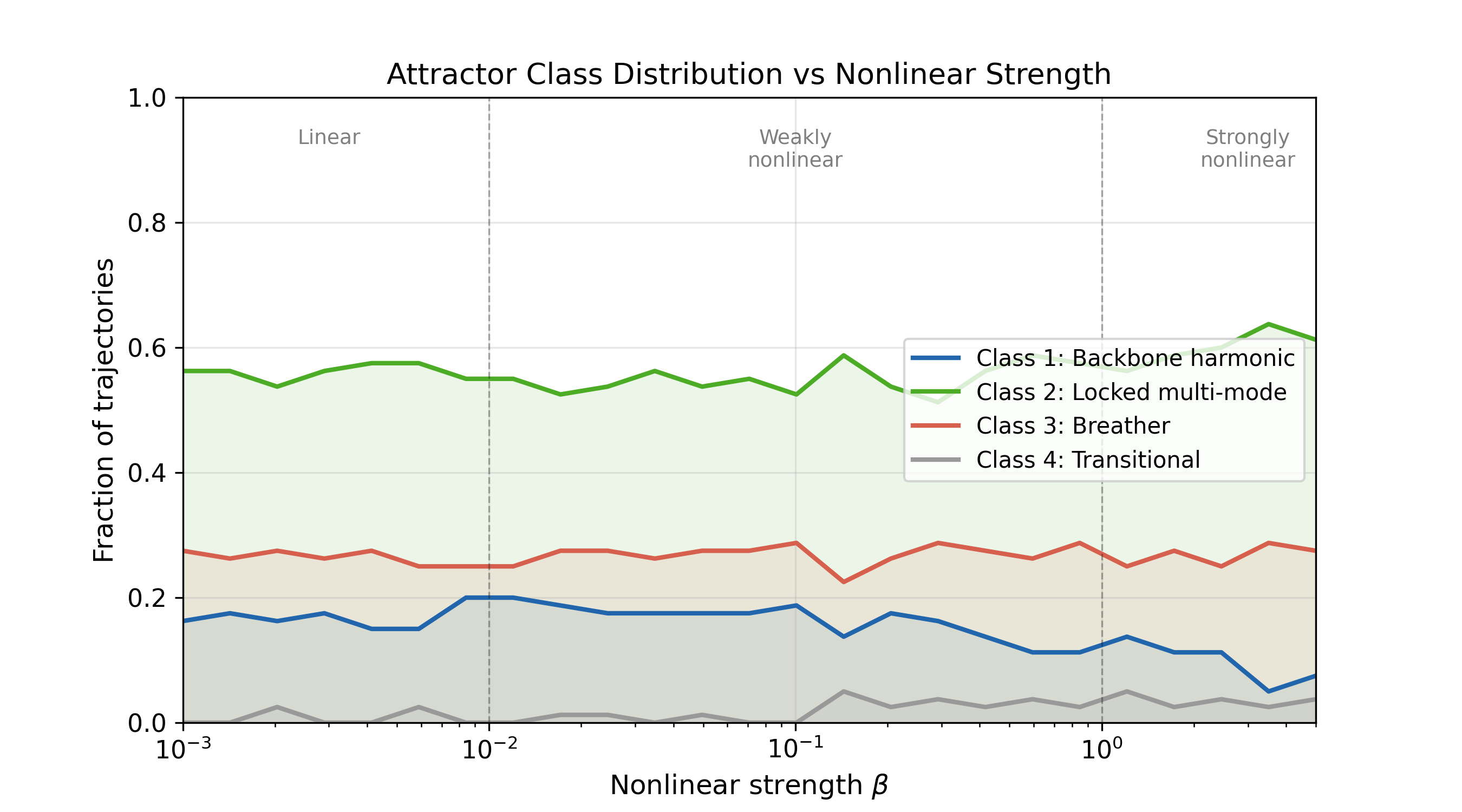
The system is Hamiltonian (energy-conserving) and is swept across nonlinear coupling strengths from β ≈ 0 (linear) through β > 1 (strongly nonlinear).
A Non-Generic Dynamical Structure
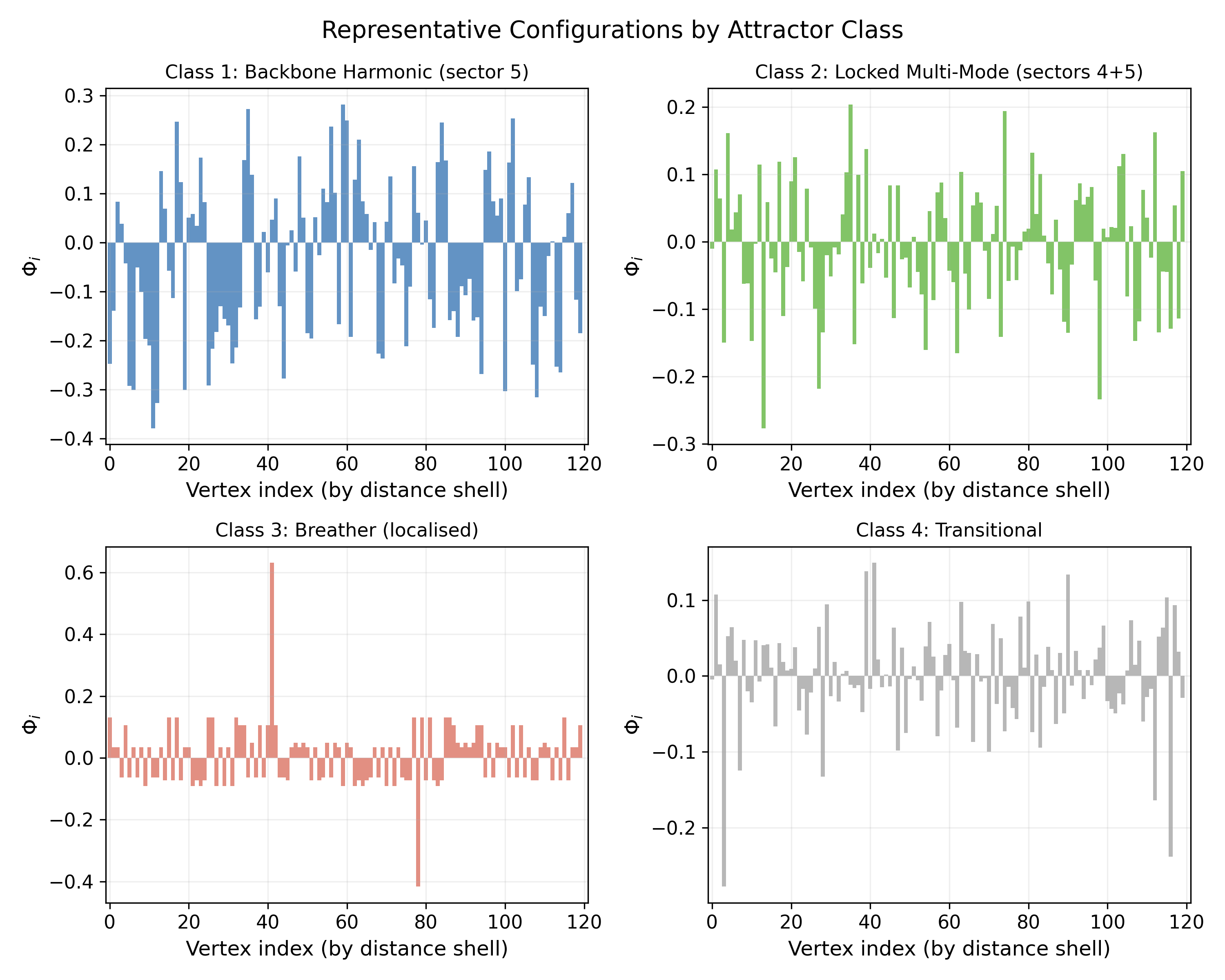
Four attractor classes are identified on the 600-cell:
| Property | H₄ (600-cell) | Random 12-reg | Rewired |
|---|---|---|---|
| Distinct eigenvalues | 9 | ~120 | ~120 |
| Structured attractors | 4 classes | unstructured | unstructured |
| Persistent breathers | present | absent | absent |
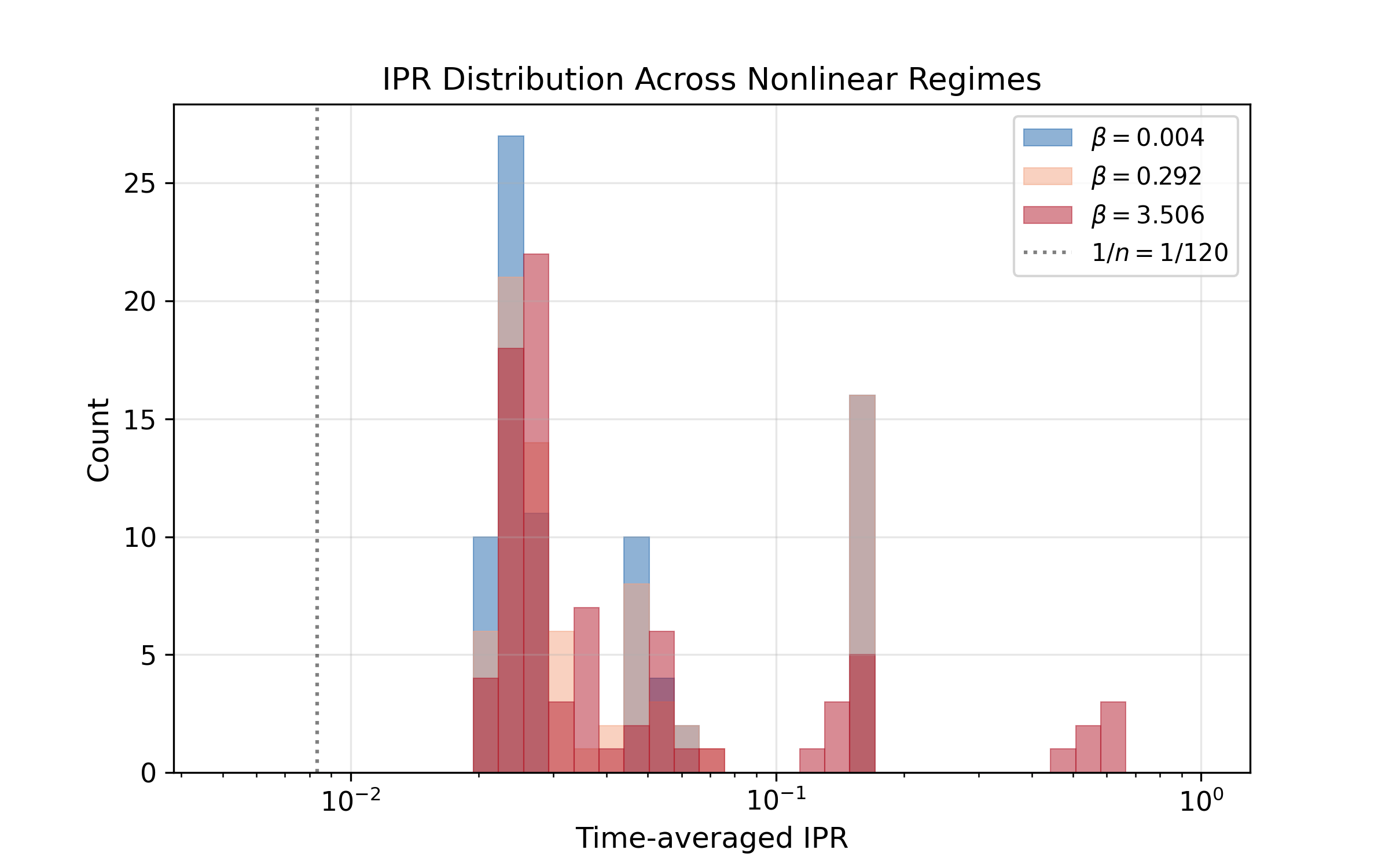
| Localisation (IPR) | 5× enhanced | baseline | baseline |
| Beat frequencies | 36 | 7,000+ | 7,000+ |
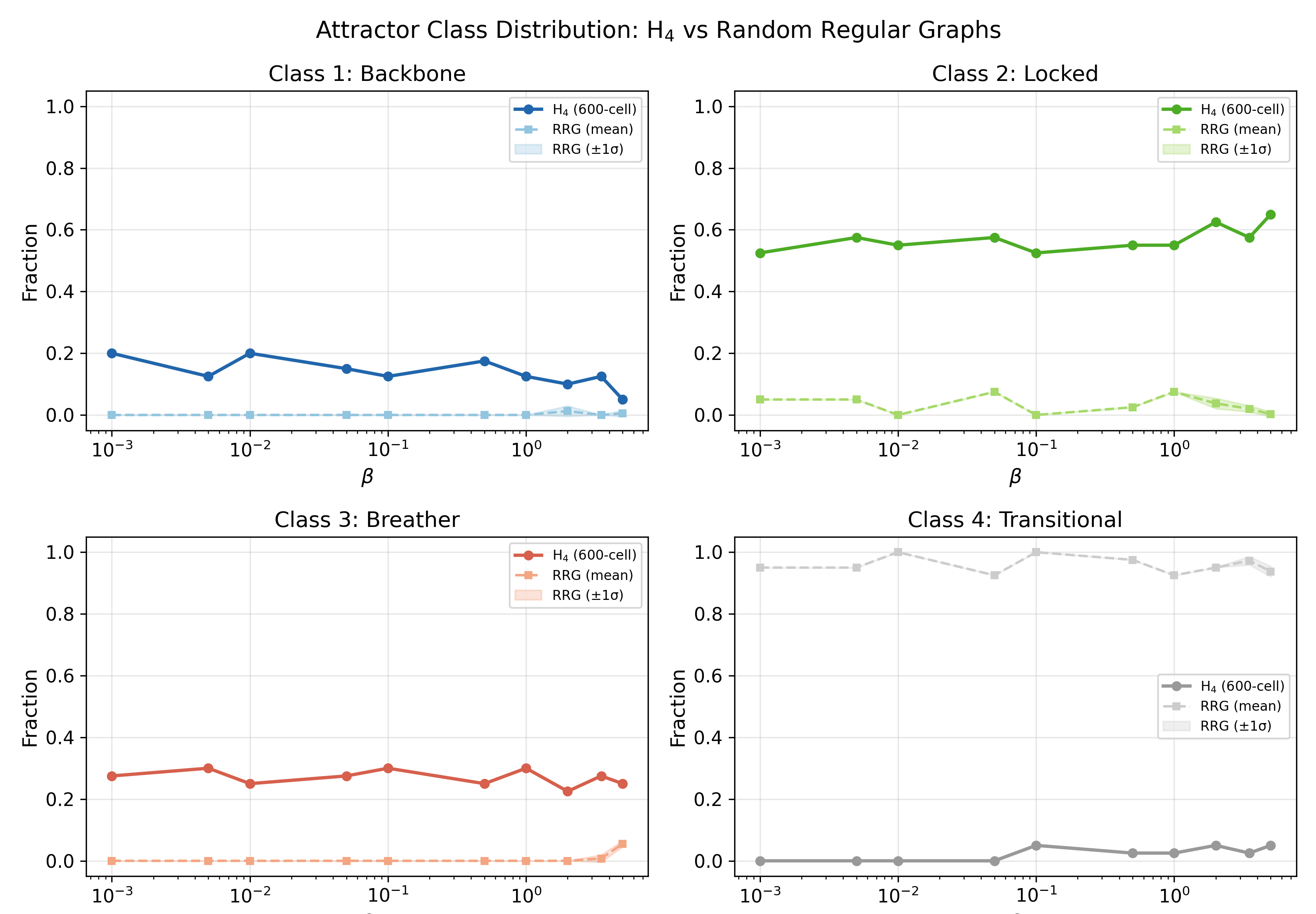
The H₄ graph produces persistent, structured dynamical states under nonlinear evolution. These states are not reproduced in degree-matched control graphs under identical conditions.
The four attractor classes are:
- Class 1 — Backbone harmonic modes: single-eigenvector states, globally distributed, low localisation. Effectively linear modes with small nonlinear corrections.
- Class 2 — Phase-locked multi-mode states: 2–4 eigenmodes locked in stable phase relationships. The most prevalent attractor family (~55% of trajectories).
- Class 3 — Localised breather states: energy concentrated on ~10 vertices, persisting for >10³ oscillation periods. Broad spectral composition spanning multiple sectors.
- Class 4 — Transitional / unstable: transient configurations that eventually settle into one of the persistent classes.
What the System Actually Does
Why This Result Is Interesting
This result shows that symmetry-constrained graphs can restrict the space of possible dynamical behaviours. The 600-cell does not merely have a compressed spectrum — that compression propagates into the nonlinear dynamics, producing a finite, classifiable set of attractor families.
This is not a generic property of nonlinear systems. It depends on the underlying structure. A random graph with the same degree and vertex count does not produce it. A rewired graph with the same degree distribution does not produce it. The effect is specific to the H₄ symmetry.
Controlled Comparison
The experimental design ensures that the observed separation is not an artefact:
- Identical parameters (ω₀, λ, β) across all graphs
- Same classification criteria and thresholds
- Graph-invariant validation — diagnostics use only IPR and persistence, not eigenmodes
- Rewired control — same degree sequence, symmetry destroyed by random edge swaps
What This Does Not Claim
- A complete physical theory
- A direct mapping to known particles or forces
- A replacement for existing physics
- That the dynamical behaviour requires a specific physical interpretation
This work establishes that H₄ symmetry constrains the attractor space of a nonlinear dynamical system on the 600-cell graph. The results are presented as properties of a well-defined mathematical system.
Symmetry does not just constrain geometry — it constrains dynamics.