The Problem
In quantum mechanics, a system in superposition — existing in multiple states simultaneously — yields a single definite outcome when measured. The standard formalism provides no dynamical account of how this happens. It simply postulates that the state "collapses" to one outcome with probability given by the Born rule.
Environment-induced decoherence suppresses interference between macroscopically distinguishable states, producing an effectively diagonal density matrix. But decoherence does not select a single outcome from the resulting mixture. The transition from improper mixture to definite fact remains unaddressed.
Spontaneous collapse models (GRW) introduce stochastic localisation at a universal rate. Penrose's objective reduction ties collapse to gravitational self-energy. Both postulate the mechanism rather than deriving it.
The Crystallisation Model
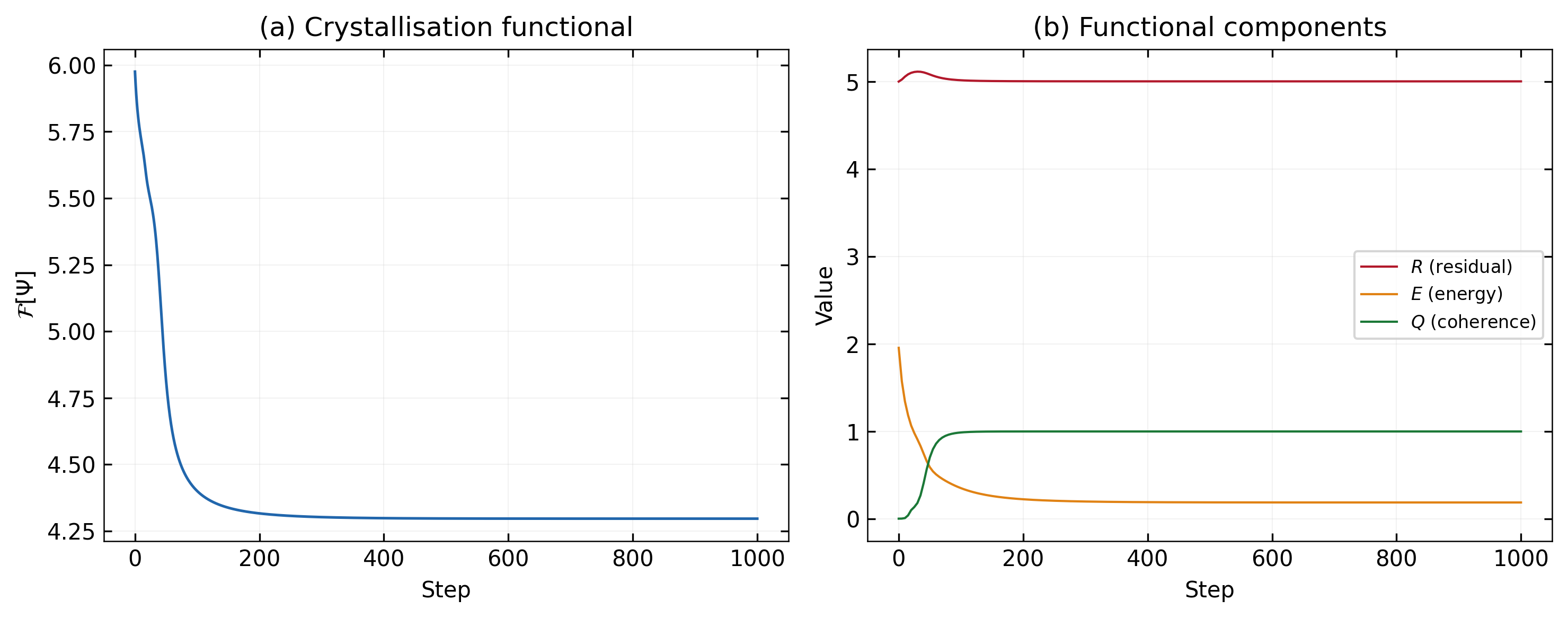
The crystallisation model proposes that state selection is not random but is the result of deterministic minimisation of a closure functional that balances three competing terms:
- Constraint satisfaction (R) — how well the state satisfies the governing constraints
- Energetic cost (E) — the energy of the configuration
- Phase coherence (Q) — the degree of phase alignment across modes
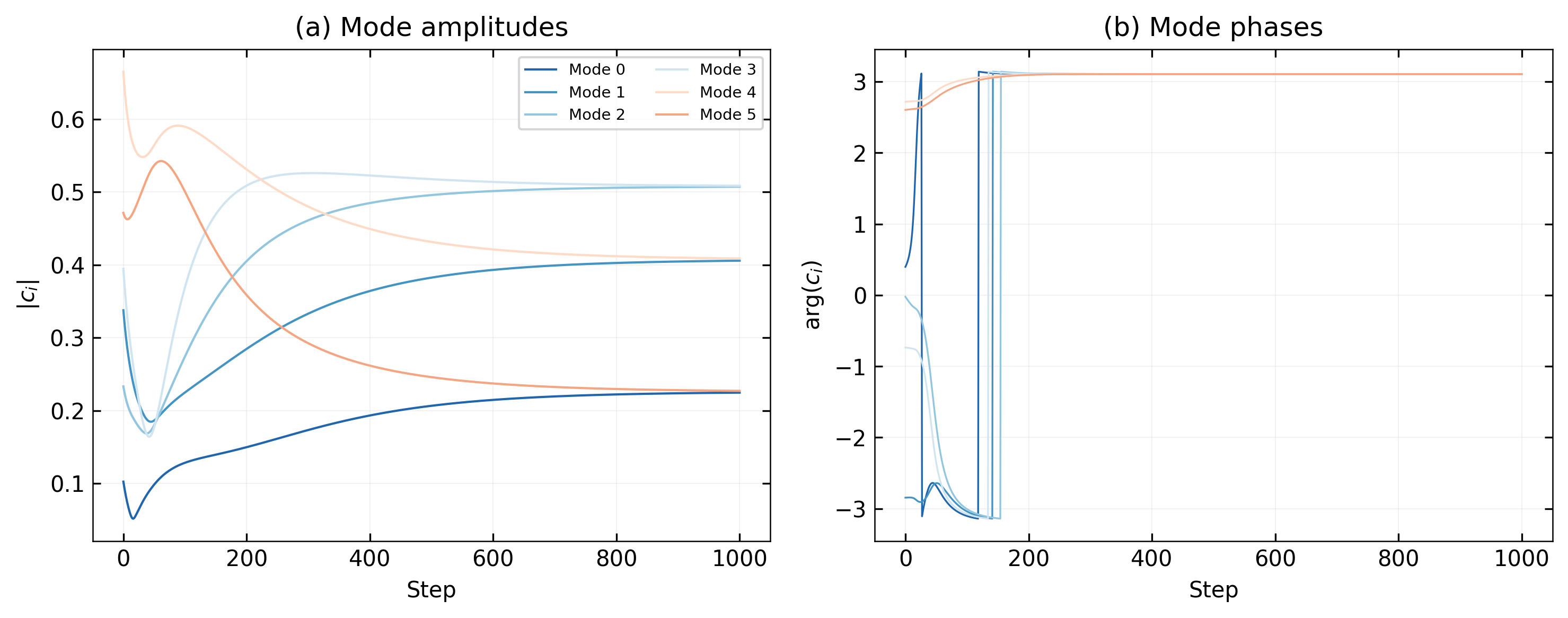
The system evolves via continuous gradient flow — following the steepest descent of the functional — until reaching a stable attractor. The selected outcome depends on the geometry of the constraint landscape, not solely on Hilbert-space amplitudes.
What appears observationally as "collapse" is reinterpreted as deterministic convergence to a constraint-compatible coherent structure — a crystal in configuration space.
How It Works
The crystallisation operator is embedded within standard open quantum system evolution. The density matrix evolves under three combined terms: unitary Hamiltonian dynamics, Lindblad environmental decoherence, and the crystallisation gradient flow.
A single parameter Δ = λ/Γ controls the crossover. When Δ ≪ 1, the system is a standard open quantum system — all predictions of standard theory are recovered exactly. When Δ ≳ 1, crystallisation effects become accessible. The transition is continuous, and the model is a strict extension of standard Lindblad dynamics.
Key Results
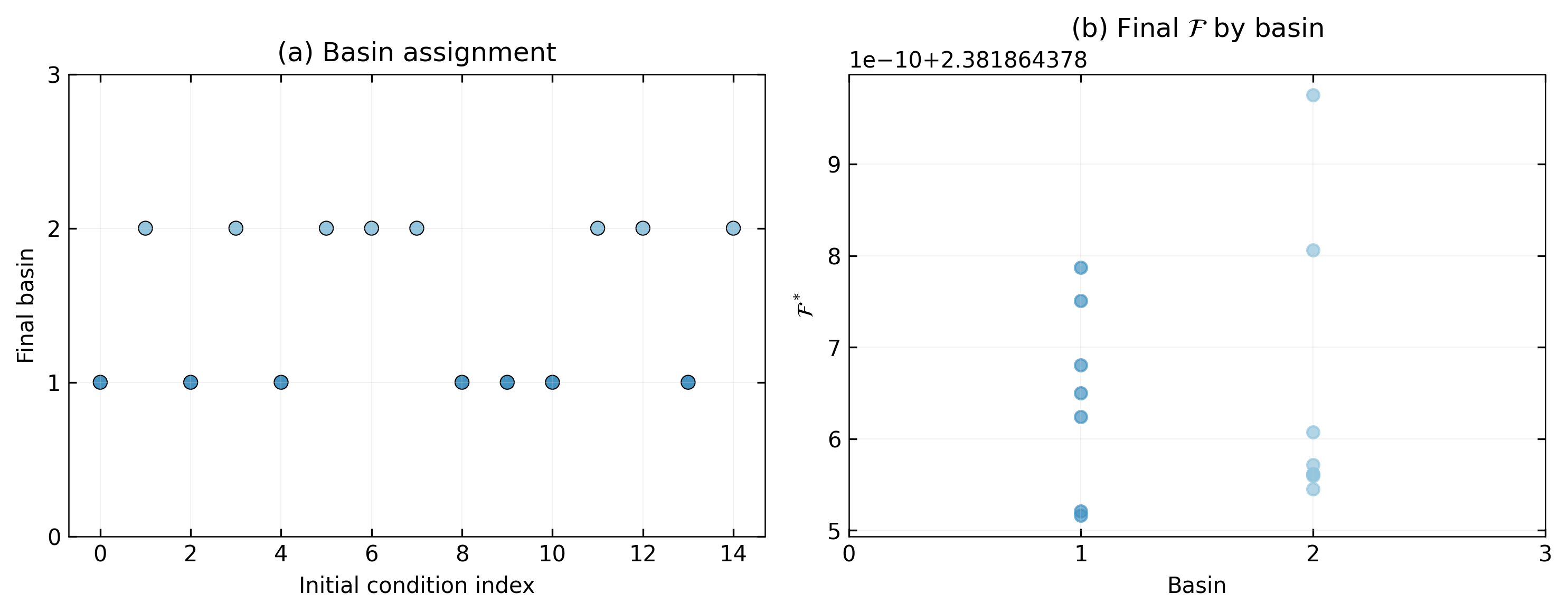
Observable Signatures
The crystallisation model predicts measurable deviations from both standard decoherence and stochastic collapse models:
| ID | Observable | Crystallisation | Standard |
|---|---|---|---|
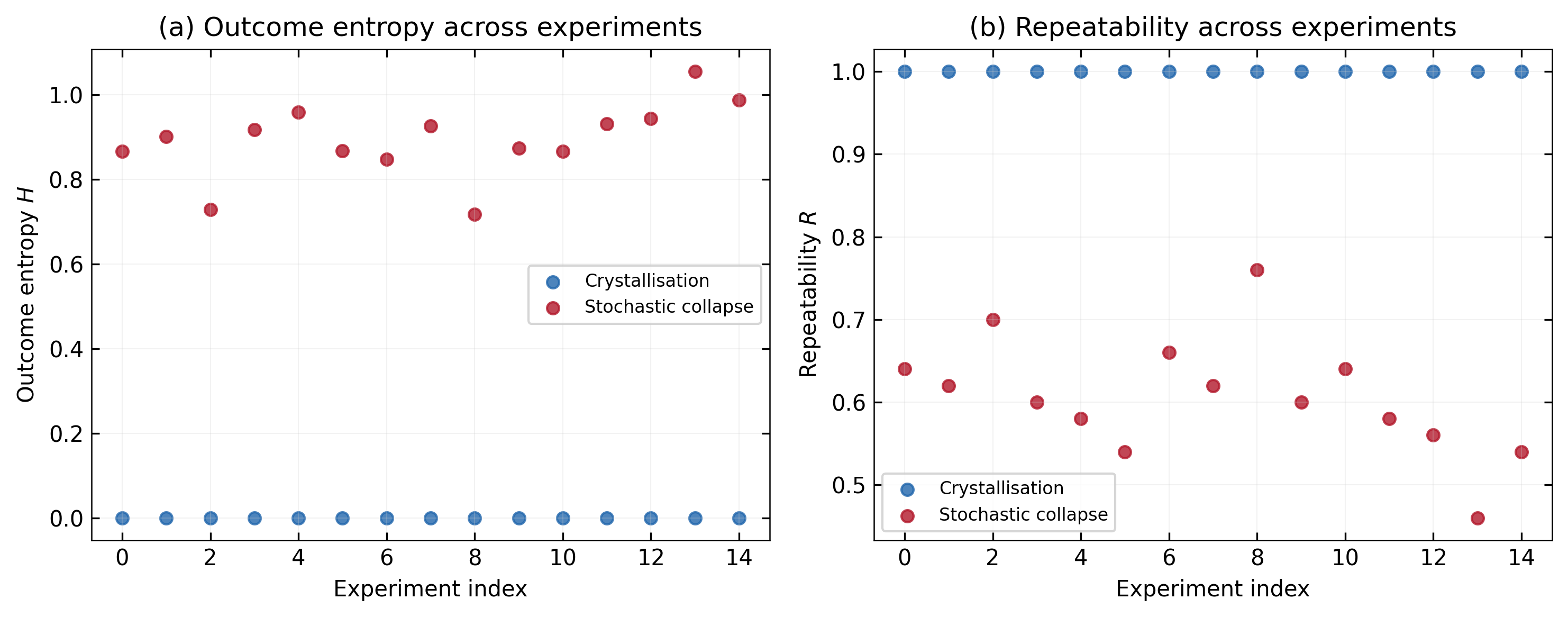
| S1 | Outcome entropy | Reduced under fixed conditions | Born-rule entropy |
| S2 | Constraint dependence | Outcome statistics vary with constraint geometry | No dependence beyond Hamiltonian |
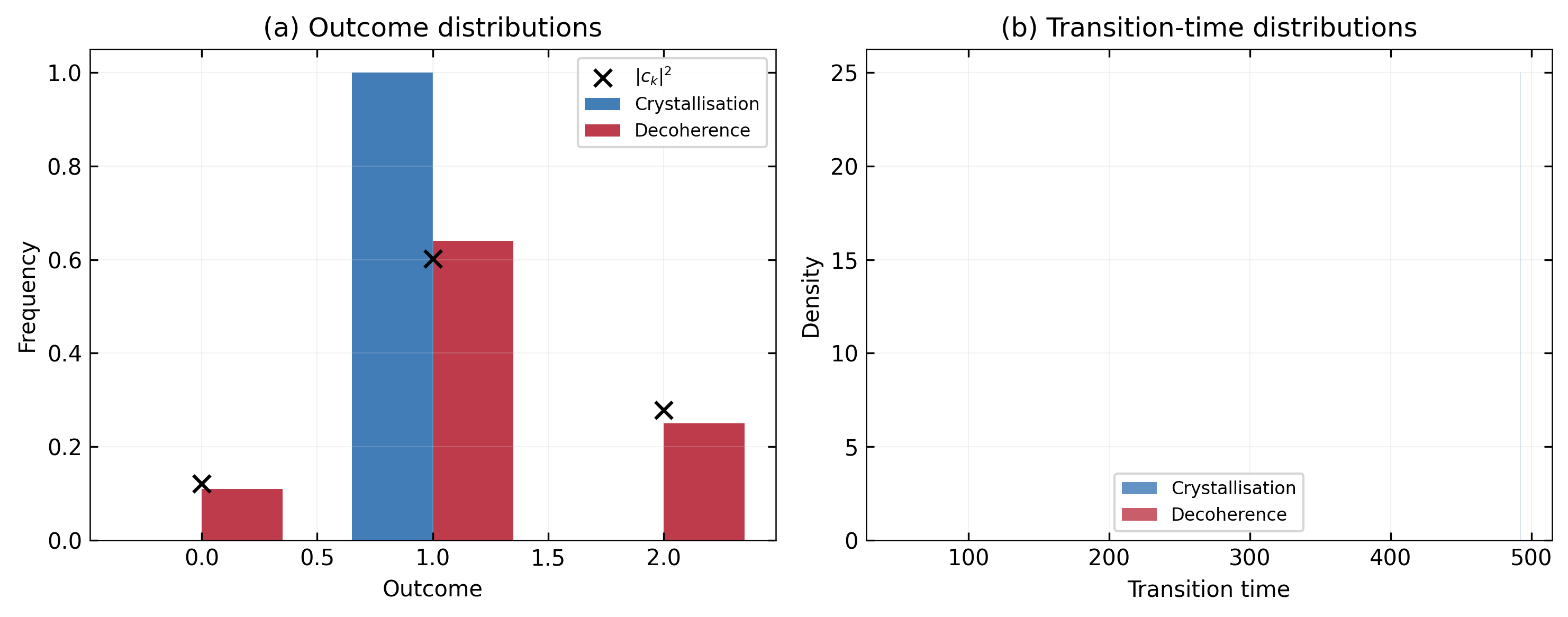
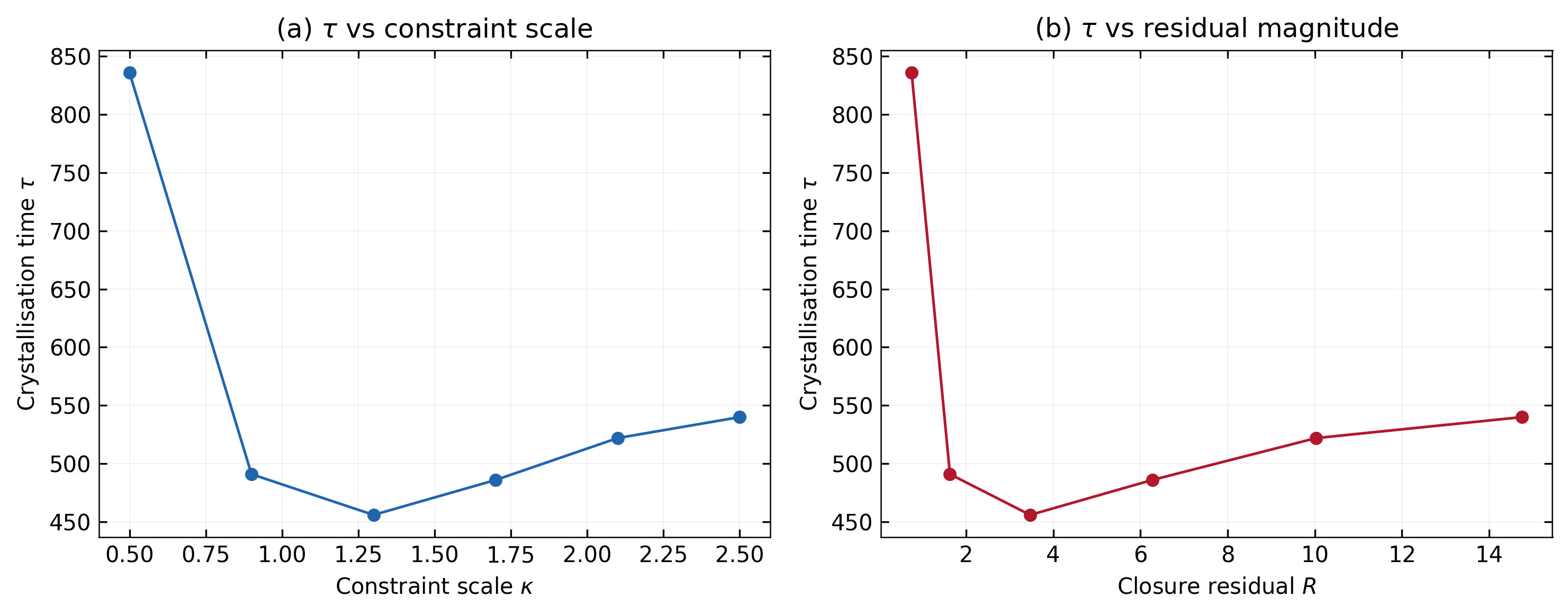
| S3 | Transition-time scaling | Multi-parameter scaling | Single-rate scaling |
| S4 | Basin preference | Bias from constraint landscape | Determined by |ck|² |
| S5 | Path reproducibility | Low trajectory dispersion | High dispersion (stochastic) |
Falsification Conditions
The model states five explicit conditions under which it should be considered falsified:
- F1. If outcome statistics show no dependence on constraint geometry beyond standard Hamiltonian effects
- F2. If transition-time scaling follows single-rate behaviour with no multi-parameter structure
- F3. If repeated trials from identical conditions show stochastic dispersion consistent with Born-rule sampling
- F4. If basin preferences are fully determined by Hilbert-space amplitudes with no constraint-landscape bias
- F5. If the closure functional does not decrease monotonically under the proposed dynamics
The experimental paper identifies five platforms where these tests could be performed: superconducting qubit systems, cold atom ensembles, optical interferometry, quantum optics, and analog oscillator networks.
The Mathematics
The formalism paper establishes three theorems:
- Existence. If the closure functional is continuous and coercive on a non-empty, closed, bounded admissible set, it attains its minimum.
- Stability. If the crystallised state is a strict local minimiser with positive-definite Hessian, it is Lyapunov-stable under the gradient flow.
- Mode selection. In the spectral formulation, coefficients asymptotically concentrate on the mode(s) minimising the closure functional, by Laplace asymptotics.
The full mathematical development, including density-matrix extension, trace preservation, and positivity analysis, is in the formalism paper.
The Code
The codebase provides a reference implementation used to generate the results in the papers and to enable independent reproduction and testing.
- Core crystallisation operator and gradient flow dynamics
- Four competing model implementations (crystallisation, Lindblad decoherence, GRW, Penrose OR)
- Falsifiability engine for statistical discrimination between models
- Parameter estimation framework
- 156 tests across four test suites
- 7 Jupyter notebooks including demos, benchmarks, and figure generation
What This Does Not Claim
- A replacement for quantum mechanics — the model is a strict extension of standard Lindblad dynamics
- That wavefunction collapse is wrong — it proposes a deterministic mechanism for the same observable phenomenon
- That the closure functional is derived from first principles — it is introduced as a modelling assumption
- That the model has been experimentally confirmed — it identifies the tests needed for confirmation or falsification
The approach is formulated as a testable dynamical extension, not a declaration. It is structured to enable independent evaluation.
State selection as structure formation rather than random projection.