
The Series So Far
Paper I established the phenomenon. Paper II identified the spectral structure. Paper III classified the attractor taxonomy. Paper IV discovered the selection rules. Paper V asks: are the attractors that do form governed by quantitative relationships?
The Numbers
The Backbone Fraction Is Not Random
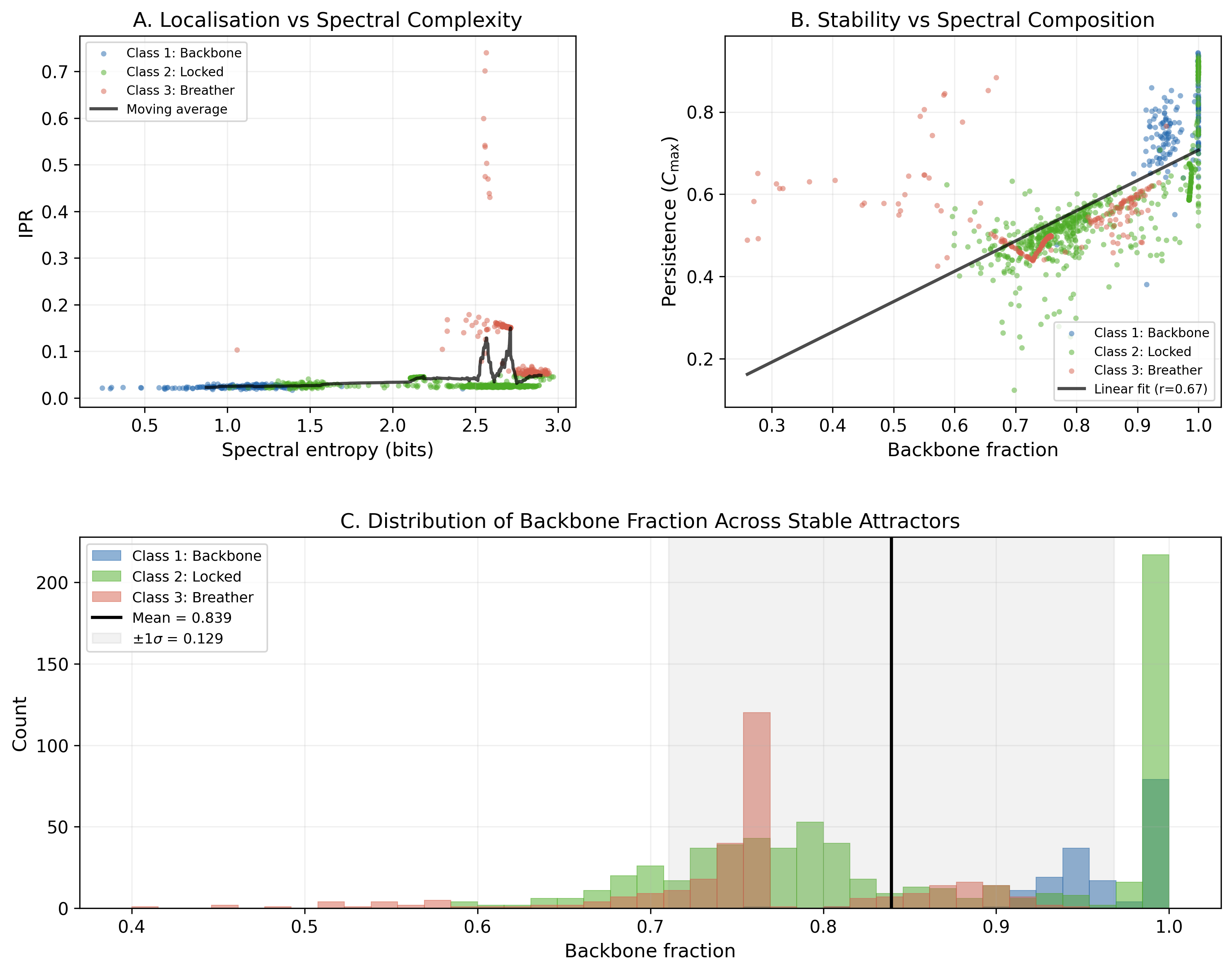
Each attractor's spectral energy can be decomposed across the nine Laplacian sectors. The fraction residing in the backbone (sectors S1–S6, comprising 91 of 120 modes) concentrates at 0.84 ± 0.13 across the full ensemble. It does not span [0, 1] uniformly.
Per class: backbone harmonic modes carry 96.7% backbone energy, locked multi-mode states 85.1%, and breather states 74.9%. Even the most spectrally broad attractors are backbone-dominated.
The backbone fraction is an empirical invariant of the attractor space. Attractors preferentially occupy a restricted region of spectral composition space — this is not imposed by construction but emerges from the nonlinear dynamics.
Three Invariant Relationships
1. Persistence correlates with backbone composition
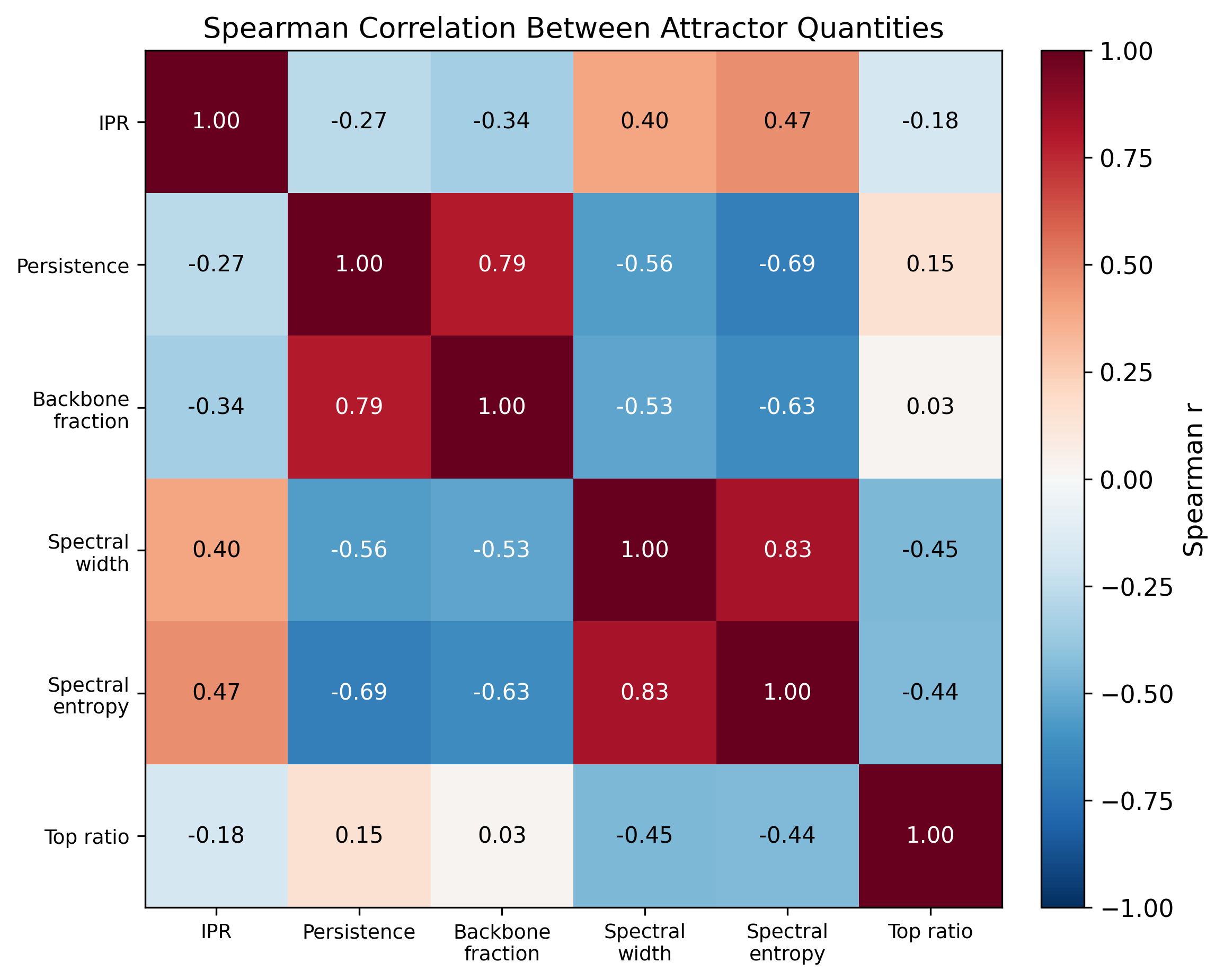
The strongest relationship in the attractor space: Spearman r = 0.79, p < 10−250. Attractors with higher backbone fraction are more temporally stable. Backbone fractions above 0.9 correspond to persistence above 0.7; fractions below 0.6 correspond to persistence below 0.4.
2. Localisation increases with spectral complexity
IPR correlates with spectral entropy: r = 0.47, p < 10−63. Attractors involving more active sectors tend to be more spatially concentrated. Broader spectral participation enables constructive interference patterns that produce localised configurations.
3. Localisation and persistence trade off
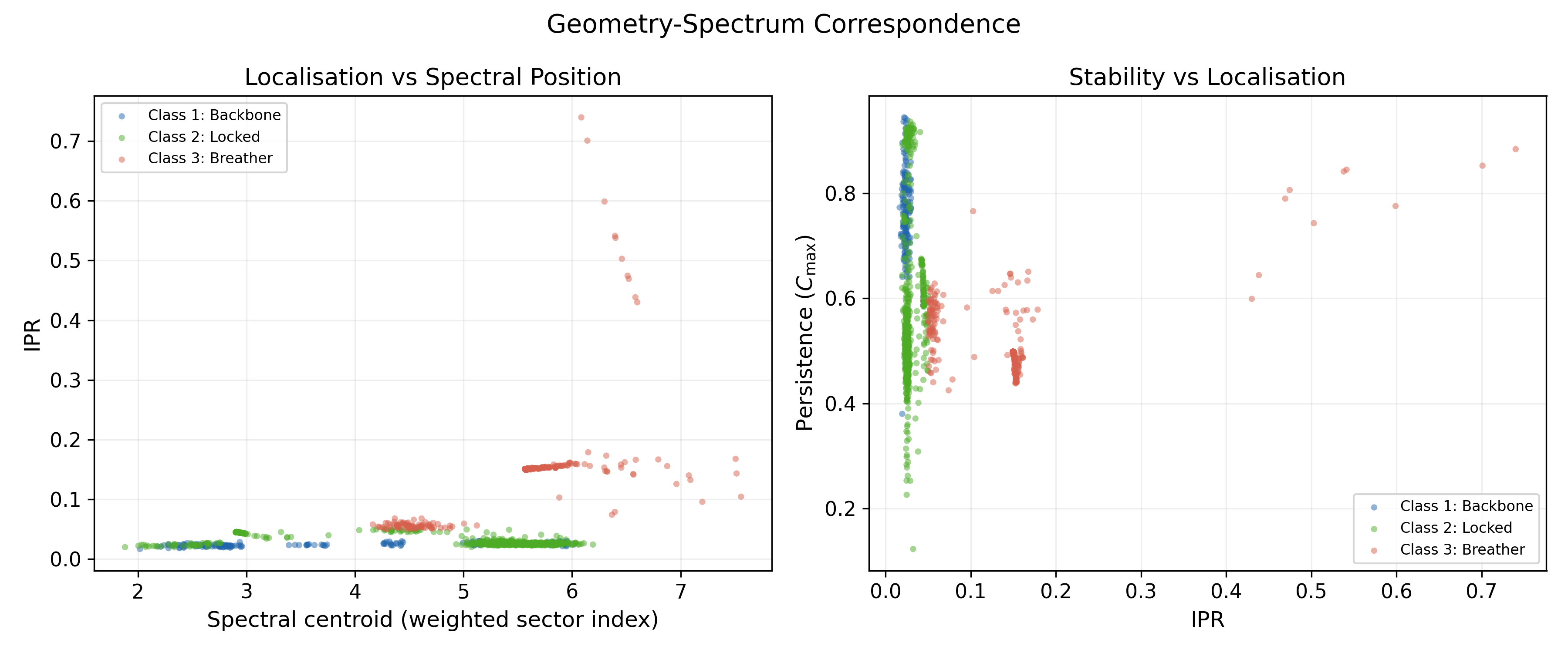
IPR and persistence are negatively correlated: r = −0.27, p < 10−20. Highly localised breather states are less temporally persistent than extended backbone modes. There is a competing tension between spatial concentration and temporal stability.
Smooth Scaling with Nonlinearity
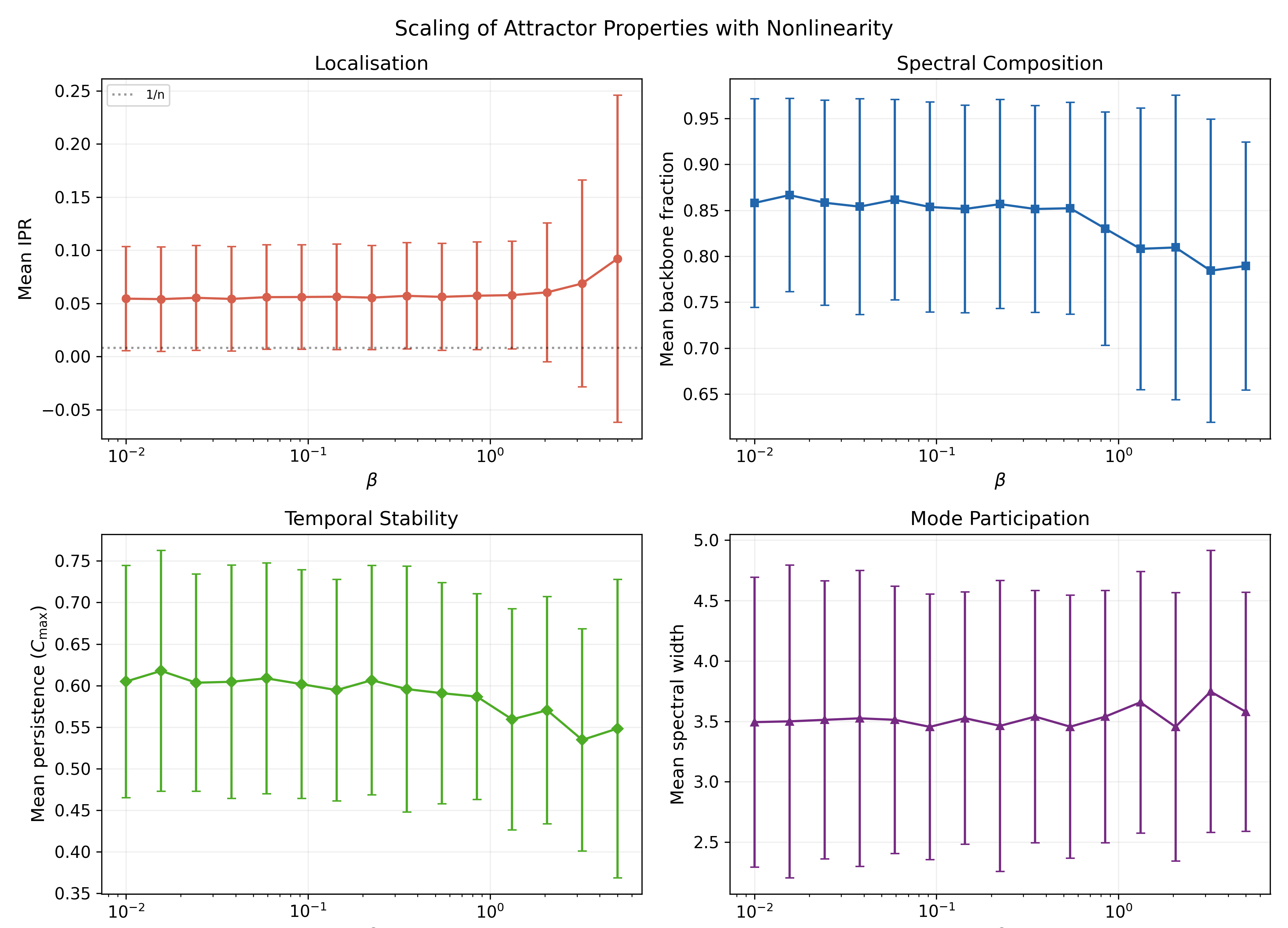
These relationships are not static. As the nonlinear coupling β increases, the attractor properties evolve smoothly and continuously:
- Localisation (IPR) increases with β as breather states become more prevalent
- Backbone fraction decreases slightly as broader spectral participation becomes possible
- Persistence decreases as the system moves from backbone-dominated to breather-dominated dynamics
- Spectral width increases as more sectors become active
There are no abrupt transitions. The attractor structure evolves along reproducible scaling curves.
Geometry and Spectrum Are Coupled
Spatial and spectral properties are not independent. Localised attractors (high IPR) tend to involve higher-index spectral sectors, while extended attractors concentrate in the lower backbone sectors. This is consistent with the observation from Paper IV that departure sectors participate primarily in spatially localised configurations.
What This Means
The attractor space of the H₄ system is not characterised by random dynamics. It is not merely constrained (Paper IV). It exhibits reproducible quantitative relationships between independent measurable properties.
The strongest relationship — the persistence–backbone correlation — is consistent with the spectral backbone invariant of Paper II: the 91-mode backbone provides a stable dynamical subspace, and attractors confined to it are more temporally persistent. The spectral algebra does not merely constrain which attractors can form — it organises them quantitatively.
What This Does Not Claim
- That the correlations establish causal relationships — they may reflect a common underlying cause
- That the invariant relationships constitute analytical derivations — they are empirical observations
- Any direct mapping to physical observables, particles, or forces
- That the results are independent of parameter choices (ω₀ = 1, λ = 1 throughout)
The H₄ spectral algebra does not merely constrain the attractor space — it organises it.