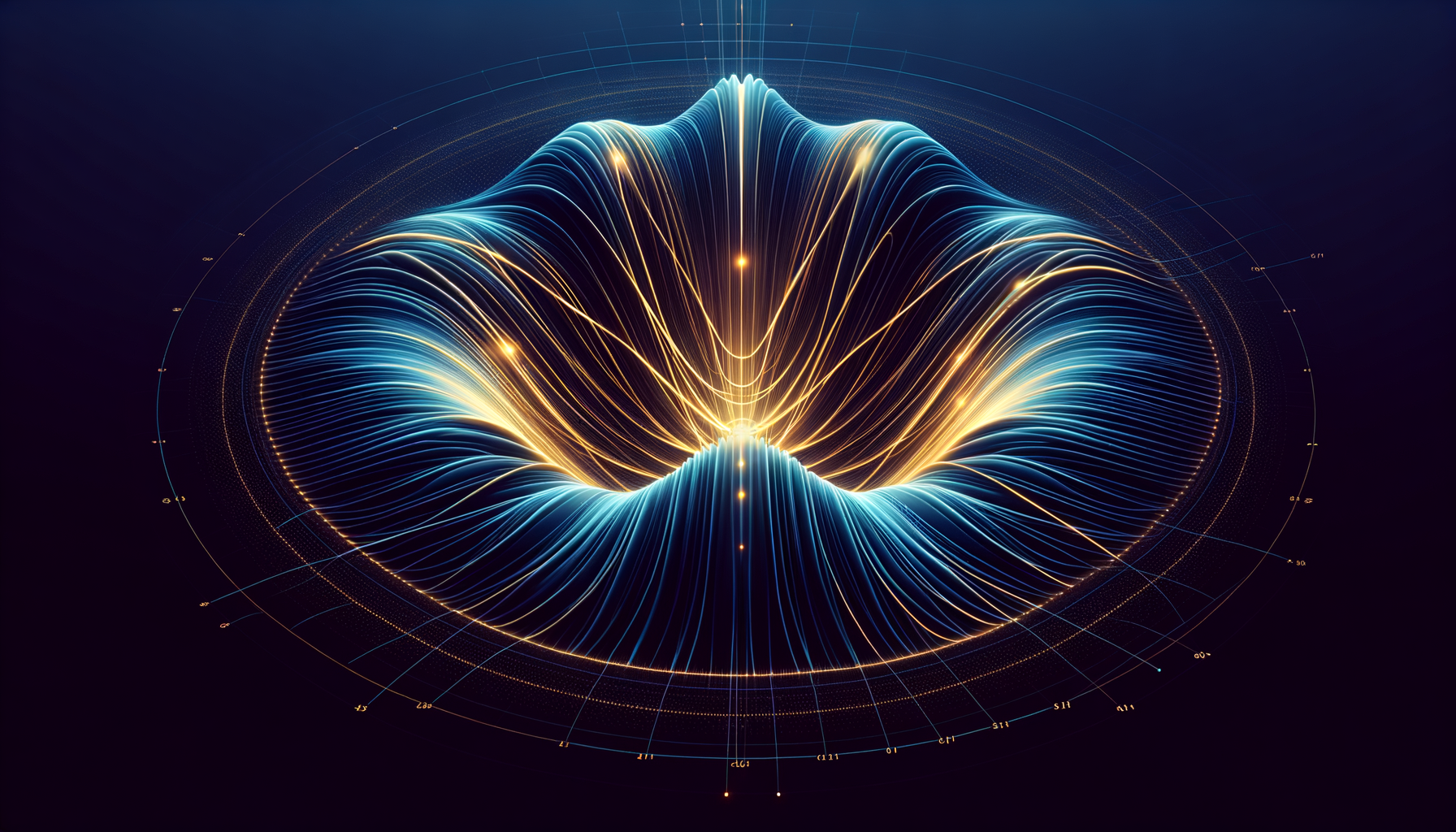
What: Source field from local event-content deviation. Accessibility potential via discrete graph Laplacian: ΔG u(e) = S(e) − S̄. Global conservation law. Three toy models: vacuum (flat), localised source (curved), perturbative (single-event response).
Source Content
The source field S(e) measures local event-content deviation — how much the local structure at event e deviates from the average. Three candidate source definitions are considered:
- Density source — local event density relative to the mean
- Overlap source — degree of neighborhood overlap between adjacent events
- Geodesic traffic source — betweenness centrality deviation (how many shortest paths pass through e)
All three candidates share the same structural property: they measure deviation from uniformity, vanish in flat geometries, and are nonzero in curved ones.
The Discrete Field Equation
The accessibility potential u(e) is governed by the graph Laplacian acting on the event set:
Source tells geometry how to distort. Geometry tells geodesics how to propagate. This is the discrete analogue of Einstein's field equations.
The graph Laplacian ΔG is the standard combinatorial Laplacian on the Hasse graph: for each event e, it computes the difference between u(e) and the average of u over its neighbours. The equation couples the source field (matter content) to the accessibility potential (geometric response).
Global Conservation
The conservation law follows directly from the field equation: the graph Laplacian has zero row-sum, so summing both sides over all events forces the total source to be constant. This is the discrete analogue of the conservation of the stress-energy tensor in general relativity.
Three Toy Models
Vacuum model
Zero source everywhere: S(e) = S̄ for all e. The field equation gives ΔG u = 0 — a harmonic potential. The geometry is flat, geodesics are uniformly distributed, and all curvature indicators vanish.
Localised source model
Source concentrated at a bottleneck region. The field equation produces a non-trivial potential that distorts the geometry around the source. Curvature indicators are nonzero, and geodesics concentrate through the source region — the discrete analogue of gravitational attraction.
Perturbative model
A single event is added to a flat background. The field equation determines the response: a localised perturbation in the accessibility potential that decays with distance. This demonstrates that the framework produces measurable geometric response to source perturbations.
What the GR Programme Establishes
GR-I: Temporal ordering from partial order on events.
GR-II: Observer kinematics from maximal chains.
GR-III: Separation geometry from three distance constructions.
GR-IV: Curvature from non-uniform event accessibility.
GR-V: Source-driven dynamics from the discrete field equation.
A complete gravitational scaffold derived from event-order structure.
Stated Limitations
- Does not derive Einstein's field equations — the discrete field equation is an analogue, not a derivation
- No continuous field dynamics — all constructions are on finite discrete event sets
- No Newtonian limit — the 1/r potential is not recovered from the discrete framework
- Toy models are illustrative — they demonstrate structural features, not physical predictions
Source tells geometry how to distort. Geometry tells geodesics how to propagate. No spacetime assumed.
Full sequence: GR-I → GR-II → GR-III → GR-IV → GR-V