Three Primitives
The formal framework is built from three primitives, no more:
Distinction
A binary partition. Something is, something is not. The minimal structural commitment any closure framework can make.
Relation
A binary association between distinguished items. The minimal commitment for non-trivial structure.
Closure operator
A self-map satisfying extensivity, monotonicity, and idempotence. Names a subset of the relation-structure as closed.
Nothing else is assumed at the outset. The closure operator does the load-bearing work; bounded reference frames, zero-lines, and the existence-frame theorems are all built on top of it inside the paper.
Bounded Reference Frames
A bounded reference frame is a closure-stable subset of the substrate together with its closure operator. Each frame carries its own zero-lines — the fixed locus of the closure operator restricted to the frame — and its own complexity grade. Frames can be nested, overlap, or be disjoint; the closure operator determines the boundary in each case.
The 600-Cell Substrate
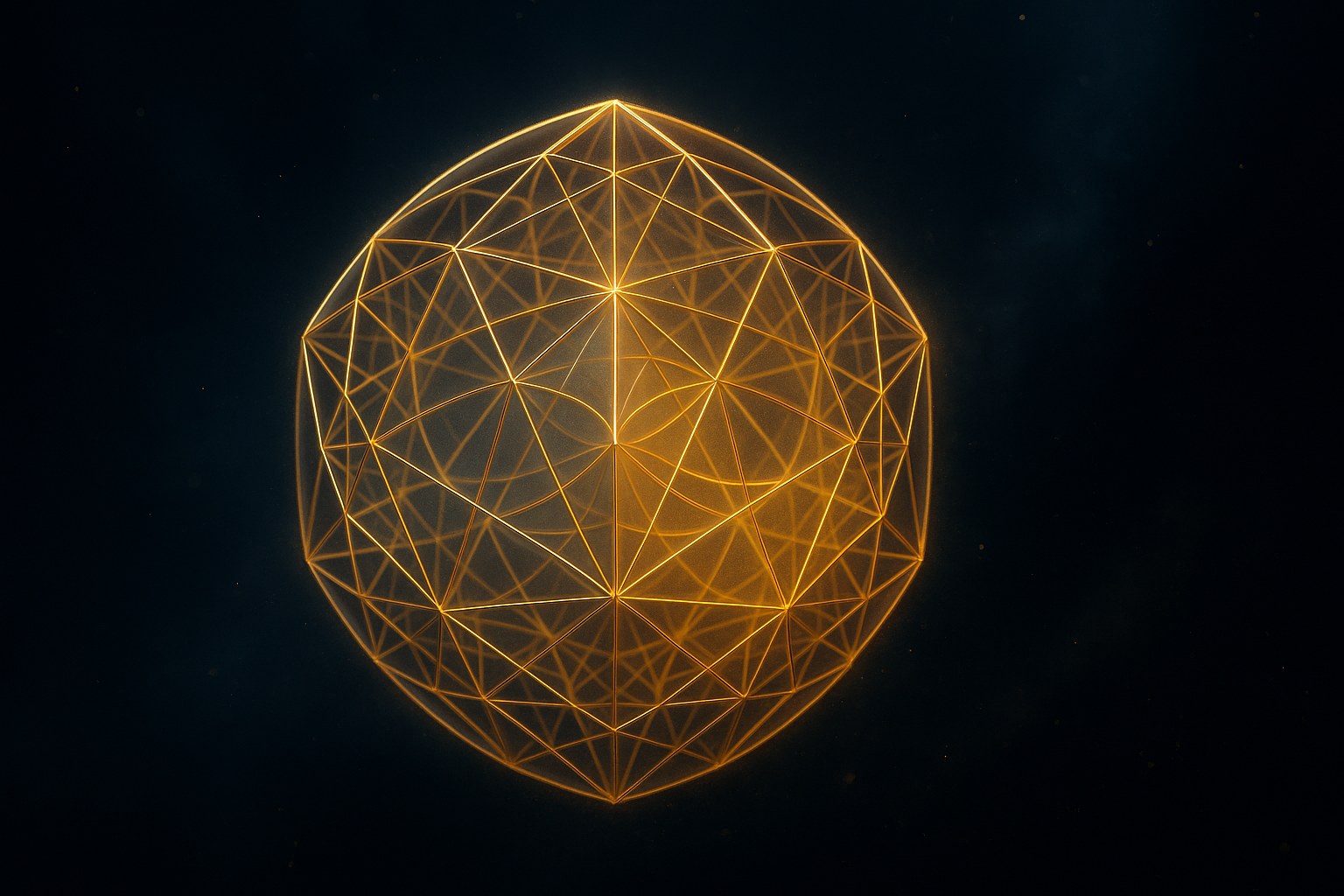
The construction is realised on the 600-cell graph — the Cayley graph of the binary icosahedral group 2I, with 120 vertices and 720 edges under H4 Coxeter symmetry. This is the same substrate that underlies the closure-response operator Cφ, the V600 programme of finite-group papers, and the 24–600 spectral bridge. Choosing this substrate is a load-bearing decision; alternative substrates are recorded as an explicit open ablation.
The σ-Twist and Two τ-Conventions
Two conventions for the closure operator's intertwining map τ appear in the literature and are both used in the wider VFD programme:
τico — icosian
The τ-map defined via the icosian quaternion ring ℤ[φ]. This is the convention used by the Schläfli decomposition and by the spectral bridge result.
τspec — spectral
The τ-map defined via the spectral σ-Galois projection. Equivalent to τico up to a documented isomorphism, but used in different proofs.
Each convention is the natural one for a different family of statements in the wider programme. Holding them distinct in the paper prevents downstream proofs from accidentally swapping conventions mid-derivation. The appendix of Paper I records the explicit isomorphism between them.
The Complexity Hierarchy
Bounded reference frames carry a complexity grade, ordered by inclusion of their closure-stable subset and by the dimension of their zero-line locus. The grade structure is what Paper II's living-frame mechanics consumes — living frames live at specific positions in the hierarchy and access specific transitions between grades.
What Is — And Is Not — Claimed
What is claimed
- A formal closure-operator framework built from three primitives — distinction, relation, and the closure operator
- Bounded reference frames and zero-lines per frame, with proofs of structural properties
- The 600-cell substrate, carrying H4 Coxeter symmetry, as the load-bearing substrate of the construction
- Two distinct τ-conventions (τico, τspec) with an explicit isomorphism between them
- A complexity hierarchy on bounded reference frames that downstream papers (II, III) consume
What is not claimed
- That the 600-cell is the unique substrate of any physical theory
- That existence is metaphysically identical to closure — the claim is structural, not metaphysical
- Living-frame mechanics or any consciousness content — reserved for Papers II and III
- Empirical correspondence to specific physical observables — this paper is foundational, not empirical
- Peer-reviewed status — pre-peer-review (v1.0.0-rc1)
Verification
Two Python scripts at papers/I-existence-as-closure/repro/ validate the substrate facts and the cascade-structure content at seed 42. Quick smoke tests complete in seconds; the full validation suite runs in a few minutes on standard hardware.
Three primitives, one operator. Bounded frames and zero-lines. The foundation paper of the programme — nothing about life, nothing about consciousness, just the load-bearing closure structure.