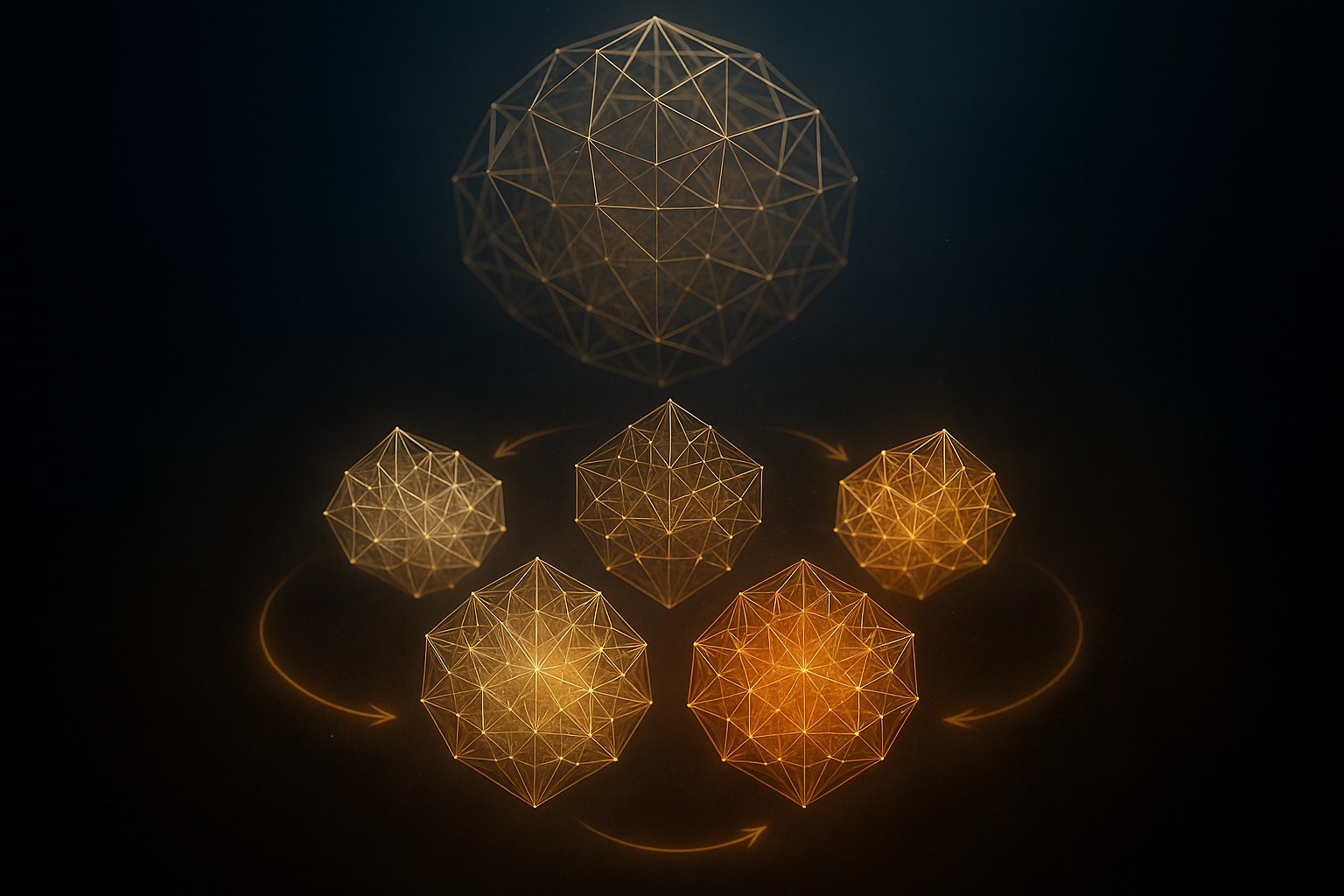
The Setup — Icosian Quaternions and Galois Fixed Sets
The 600-cell, viewed as a finite group, is the binary icosahedral group 2I — the 120 unit icosian quaternions. Coordinates are exact elements of the ring ℤ[φ] of the golden field. The Galois automorphism σ: √5 ↦ −√5 acts vertex-wise on the icosian coordinates.
V600 = 2I
120 unit icosian quaternions. The vertex set of the 600-cell, with finite-group structure: binary icosahedral.
2T = Fix(σ)
The binary tetrahedral group of order 24, characterised as the σ-fixed subset of 2I under the Galois twist σ: √5 ↦ −√5. Geometrically, the vertex set of the 24-cell.
Theorem 3 — The Five-Coset Partition
The main combinatorial statement of the paper:
Each subset Ci carries the intrinsic 24-cell distance structure: an 8-regular graph at squared distance 1, with 96 edges. The geometric content of each coset is therefore a genuine 24-cell — not just a 24-element set of vertices, but the full edge structure of the regular 4-polytope, restored from inner-product distances alone.
Theorem 5 — The Induced A5 Action
Left-multiplication by elements of 2I permutes the five cosets, inducing a homomorphism
Transitive
The action is transitive on the five cosets — every coset is reached from every other by some element of 2I.
Image of size 60
The image of the homomorphism has exactly 60 elements — half the order of 2I, exactly matching |A5|.
Kernel is the centre
The kernel of the action is exactly {+1, −1}, the centre Z(2I). The non-trivial central element acts trivially on the coset set.
Image is A5, not all of S5
The action lands entirely inside the alternating group A5 ⊂ S5. No element of 2I induces an odd permutation of the cosets.
Combining the four properties: the homomorphism factors through 2I / {+1, −1} ≅ I (the icosahedral rotation group, of order 60) and lands isomorphically onto A5. The induced 2I-action on the cosets is exactly the standard isomorphism I ≅ A5 made concrete by the partition.
Why The Partition Matters
The Schläfli decomposition isolates two load-bearing facts that downstream constructions can cite without re-deriving:
- A clean five-block split with geometric content. Each block is not just a coset of an abstract subgroup but a 24-cell carrying its own metric structure.
- A concrete A5-action. Every downstream result that wants to use the icosahedral symmetry of the 600-cell as A5 can point to this partition for the concrete realisation.
- A Galois characterisation of 2T ⊂ 2I. The subgroup is not chosen by hand — it is forced by the σ-fixed-set characterisation in the icosian ring.
Verification
All claims are verified in exact rational arithmetic using the vendored vfd_v600 icosian quaternion package. The five cosets are enumerated as explicit element lists; the coset-action table is recorded in outputs/coset_action_table.csv; the distance shells of each block are recorded in outputs/distance_shells.csv and confirm the 8-regular graph structure of the 24-cell at squared distance 1 with 96 edges. The reproducibility log is frozen in outputs/reproducibility_log.txt.
Figures: coset partition, group inclusion 2T < 2I, distance shells, coset action permutations. NumPy/SciPy are used only as independent floating-point cross-checks; the source of truth is the exact-rational computation.
What Is Explicitly Out of Scope
- Any physical interpretation of the partition — this is finite geometry, no more
- Spectral content of the partition — reserved for Paper 02 (the 24–600 spectral bridge)
- Generalisations to other regular 4-polytopes (24-cell, 120-cell) or higher-dimensional analogues
- Claims that 2I is the unique substrate of any physical theory
- Standard Model, cosmology, black-hole, or consciousness content
The 600-cell partitions into five 24-cells. The induced symmetry is A5, with the centre as kernel. Foundation laid — nothing more, nothing less.