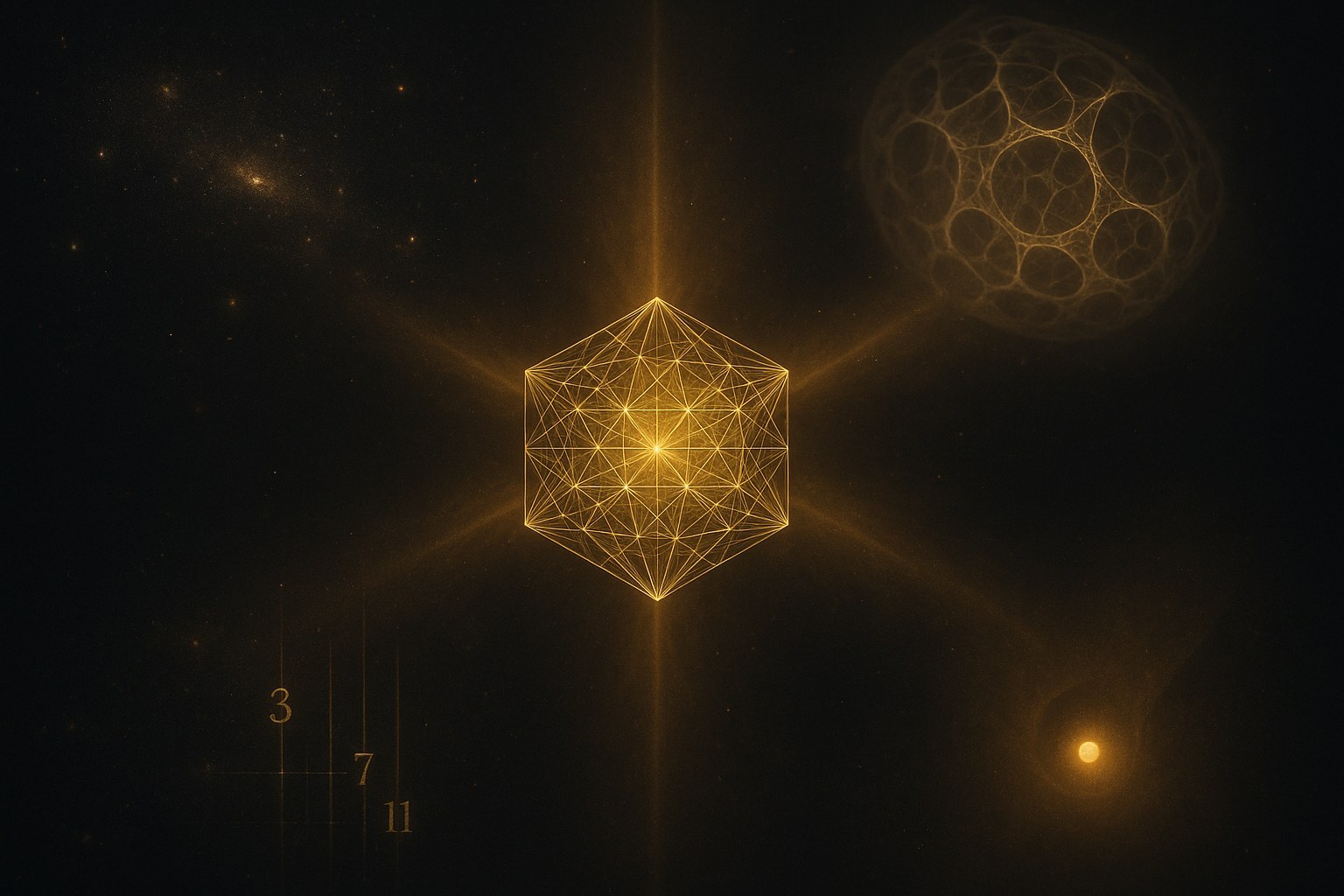
One Substrate, Four Domains
The compendium develops a single mathematical substrate — the 600-cell graph V600 = 2I with its closure operator Cφ and the icosian triad (ℐ, G, C) — and then traces how it appears across four distinct empirical or formal domains. The same operator algebra carries the picture in each domain; the differences live in what observable each domain measures.
Closure & universe
The cascade-derived Λ and H0. The hypersphere cosmology preprint: all seven cosmological observables within 0.5% of Planck 2018, with the closure operator carrying the φ-cascade and the cascade-derived dipole δΛ.
Closure & life
Microtubule dipole correspondences, anaesthetics phenomenology, bioelectric closure. The closure operator restricted to a living frame, with the empirical proxies of the E/L/C programme notes A–F as the anchors.
Closure & mind
Cortical phase, propofol-induced transitions, point-of-view formation under the Access Principle. The closure operator restricted to a cortical living frame, with Note B as the strongest current empirical anchor.
Closure & number
The Euler bridge from V600 to ℚ(√5), ζ(s) appearing as a Dedekind factor in the icosian L-function. The Icosian Closure Object reaches the positivity wall and names the one open step (a single cuspidal GRH); its follow-on, a geometric equivalent of RH, proves QA ≥ 0 ⇔ RH(L). No claim about the Riemann Hypothesis — an equivalence is proved, not the positivity; the ζ appearance is structural.
The Compendium — Ten Sections
The compendium follows a deliberate ten-section arc that takes the reader from a one-page picture through the mathematical core to the four-domain map and the scope discipline that closes the document.
| § | Topic | Focus |
|---|---|---|
| 1 | Picture in one page | The thesis and the epistemology in a single page. The compendium's elevator pitch. |
| 2 | Three forms of closure | Substrate, closure, and generation as verbs. The icosian triad introduced informally. |
| 3 | Mathematical core | V600, Cφ, NH, and σ-pairing summarised. Pointers to the icosian-triad preprint bundle for proofs. |
| 4 | Closure & universe | Λ, H0, and the hypersphere cosmology cascade. Bridge interpretation, not derivation. |
| 5 | Closure & life | Microtubules, anaesthetics, bioelectric closure. Proxy anchors from the E/L/C programme. |
| 6 | Closure & mind | Cortical phase, propofol, point-of-view formation. The Access Principle named as conjecture. |
| 7 | Closure & number | The Euler bridge and the icosian L-function. No RH claim. |
| 8 | Closure & recurrence | Cosmic-scale closure as a speculative extension. Explicitly marked speculative. |
| 9 | Scope discipline | The four-tier framework plus falsifiers per claim. The bridge-status registry. |
| 10 | Reader's map | Domain-specific entry sequences for physicists, biologists, neuroscientists, mathematicians, philosophers, and sceptics. |
The Four-Tier Scope Framework
The compendium's load-bearing epistemic move is its four-tier framework. Every claim across the VFD programme — in any of the four domains — is placed in one of four tiers, and falsifiers are stated per claim. The bridge-status registry on the closure-picture compendium lists, for each claim, which tier it lives in and which falsifier could decide it.
Mathematical theorem
Proved unconditionally; verification certificate available. The closure operator's spectral identity, the icosian L-function decomposition, the 600-cell coset partition, the spectral bridge lift identity.
Conditional bridge
A specific empirical match conditional on a stated bridge hypothesis. The hypersphere Λ-match (conditional on the cascade-bridge interpretation), the V600 trace ratios for H0/S8 (conditional on the Layer-3 sign assignment).
Empirical proxy
A measurable stand-in for a formal closure operator. The CAD-D1–D5-v1 diagnostic framework; Note B's cortical phase closure; Note A's bioelectric proxy; the FlowIndex and dyadic protocols.
Named conjecture
An explicit hypothesis treated as conjecture, never asserted as theorem. The Access Principle (P-A); the cosmic-recurrence extension; the speculative material in extensions_withheld/.
The Bridge-Status Registry
For every interpretive claim in the compendium, the bridge-status registry records: (a) which tier it lives in, (b) which prior preprint contains the theorem-grade content it depends on, and (c) which observable measurement would falsify it. The registry is the compendium's structural commitment to scope discipline. A claim that does not fit into a tier and does not name its falsifier is not in the registry — and not in the compendium.
Reader's Map — Where to Start
Section 10 of the compendium ships six domain-specific entry sequences. The site reflects these directly — choose the entry point closest to your background:
Cosmology first
Hypersphere cosmology → V600 programme cosmic-tensions → icosian-triad mathematical core. Look for the cascade derivation and falsifiers.
Life first
Existence/Life/Closure programme Paper II → E/L/C Notes A and C → closure-picture §5. The microtubule and bioelectric proxies.
Mind first
E/L/C Note B (cortical phase, the strongest anchor) → E/L/C Paper III → closure-picture §6. Bridges B1–B3 with explicit conditional status.
Algebra first
Icosian-triad Paper 1 (core math) → the Schläfli decomposition → V600 programme. Bose–Mesner scheme, Z[φ] eigenvalues, the L-function identity.
Existence first
E/L/C Paper I → closure-picture §2 and §9 → E/L/C Paper III. The closure-as-existence move and what it does/doesn't claim.
Falsifiers first
closure-picture §9 (scope discipline, the registry) → the four-tier framework → the strongest individual falsifier for whichever domain you most want to disprove.
What Is — And Is Not — Claimed
What is claimed
- A programme manifesto: an integration document that names the field narrative, lists the falsifiers, and points to the underlying preprints
- An entry point to the wider VFD programme, with six domain-specific reader sequences
- A four-tier scope framework (theorem / conditional bridge / empirical proxy / named conjecture) applied uniformly across all four domains
- A bridge-status registry that lists, for every interpretive claim, its tier, its underlying preprint, and its falsifier
- That the same closure operator appears in cosmology, life, mind, and number across the existing VFD releases — with the cross-references explicit
What is not claimed
- No new mathematics — every proof is in a cited preprint
- No new empirical claims — every measurement is anchored to a prior release
- No claim about the Riemann Hypothesis — the ζ(s) appearance is structural, not a derivation
- No claim that consciousness, life, or cosmology have been solved by closure mathematics
- No claim that the closure construction is unique — alternative substrates remain an explicit open ablation
- Peer-reviewed status — pre-peer-review, not independently validated
One substrate, four domains, ten sections. A programme manifesto with explicit scope discipline and falsifiers per claim. Not a new theory — a reader's map across the existing one.